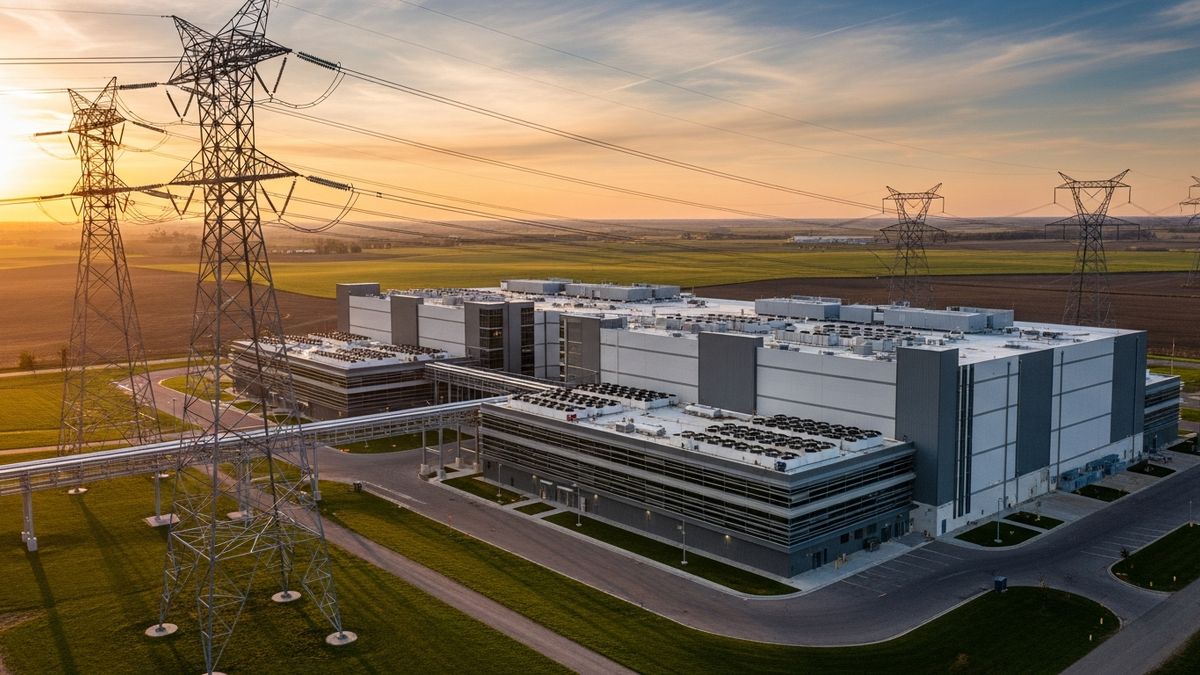
Data Centers Drove 70% of Illinois's Capacity Cost Spike — Here's What That Means for Your Bill
I've been getting a version of the same question from customers for months now. They've seen posts on Facebook about how much electricity AI uses. They've watched videos about data centers consuming enough power to run entire cities. And they're connecting the dots — if tech companies keep building these facilities, electric bills are going to keep going up.
They're right. The numbers are worse than most people realize.
70% of the Cost Spike Came From Data Centers
PJM's Independent Market Monitor found that 70% — or $9.3 billion — of last year's capacity cost increase was driven by data center demand. That's not a vague "contributing factor." That's the primary driver, and every residential customer in Illinois is paying for it.
PJM operates the grid for northern Illinois (ComEd territory). MISO operates it for central and southern Illinois (Ameren territory). Both grids are getting squeezed.
On the PJM side, capacity auction prices went from $28.92/MW-day in 2024 to $329.17/MW-day for 2026-2027. That's more than a 1,000% increase in two years. On the MISO side, summer capacity prices jumped from $30 to $666.50/MW-day in a single year — a 22x spike.
Those numbers flow directly into the rate you pay per kilowatt-hour. There's no buffer between the auction and your bill.
How Much Power Are We Talking About?
A single large data center can consume 600 megawatts. That's roughly what an entire mid-size city uses. PJM projects that data center demand will add 32 gigawatts of peak load by 2030, and all but 2 gigawatts of that growth comes specifically from data centers.
Illinois already had 30 additional data centers planned as of late 2024. Data centers consumed 5.43% of all electricity in the state by January 2025, and that share is climbing fast.
And these aren't small operations. In Joliet, a $20 billion, 795-acre data center campus would consume up to 1.8 gigawatts — the largest in Illinois. The plan commission voted to advance it despite significant resident backlash. Meta is building a $1 billion facility in DeKalb. Microsoft has campuses going up in Cherry Valley (350 acres, 4-6 buildings) and Hoffman Estates ($500M+). T5 Data Centers is building a 480-megawatt campus in Grayslake. Prime Data Centers broke ground on a $1 billion campus in Elk Grove Village.
If you live near any of these towns, you already know. Residents in Joliet packed public hearings. The city council delayed its vote after a marathon session. People are paying attention.
The Citizens Utility Board warns this trajectory could mean "rolling blackouts and bill spikes by up to $70 a month" within years if nothing changes. NRDC projects $21.4 billion in cumulative capacity costs for ComEd territory alone between 2028 and 2033.
Illinois Is Starting to Push Back
I talk to homeowners across the state — Belleville, Aurora, Champaign, Peoria — and many of them aren't just worried about cost. They're ready to fight to keep data centers out of their communities. The state legislature is hearing them.
The POWER Act (SB2181), introduced by Sen. Ram Villivalam and Rep. Robyn Gabel, would require data centers to pay for their own energy costs instead of passing them to residents. It also mandates renewable energy sourcing, water usage reporting, and community benefit agreements. It has bipartisan support and is currently in committee.
Governor Pritzker announced a two-year suspension of state tax incentives for new data center developments, effective July 1, 2026.
Local governments aren't waiting for Springfield. Aurora enacted a 180-day moratorium on new data center construction and is now drafting ordinances requiring energy, water, and noise impact studies from developers. Champaign County is considering a 12-month moratorium on data centers over 10,000 square feet. McLean County passed zoning rules limiting data centers to manufacturing zones — specifically to protect farmland. Naperville, Yorkville, and Lisle all have data centers on their council agendas.
These are meaningful steps. But they won't undo the capacity costs already locked in from the 2025 and 2026 auctions. Even with reform, elevated rates are here for years.
Where Your Rate Stands Today
ComEd's all-in residential rate sits at approximately 17.07¢/kWh — up 90% from five years ago. Another increase is expected in June 2026 when new capacity costs kick in.
Ameren Illinois customers pay about 15.5¢/kWh on average. That MISO capacity jump to $666.50/MW-day means Ameren's summer rates will be volatile again. And Ameren has already told regulators it plans to file another rate increase request in 2026.
| | ComEd | Ameren IL | |---|---|---| | Current avg rate | ~17¢/kWh | ~15.5¢/kWh | | 5-year increase | +90% | +94% | | Grid operator | PJM | MISO | | Capacity price spike | $29 → $329/MW-day | $30 → $667/MW-day | | Next rate change | June 2026 | June 2026 |
Both columns point in the same direction.
The Blackout Question
Cost isn't the only thing keeping people up at night. When you hear "rolling blackouts" from a consumer watchdog like CUB, it hits different.
PJM actually failed to meet its reliability target in the 2027-2028 capacity auction — they couldn't secure enough resources to maintain a 20% reserve margin. MISO's reserve margin dropped from 6.5 GW to 2.6 GW in two years. These aren't hypotheticals. This is the grid telling us it's running out of headroom.
I've noticed more customers asking about battery backup in the last six months than in the previous two years combined. A solar battery system means stored power when the grid goes down. During last summer's heat waves, some ComEd customers lost power for days. A battery keeps your refrigerator running, your sump pump working, and your family comfortable.
Illinois offers a $300/kWh storage rebate through Illinois Shines, which brings the cost down significantly. I did a full breakdown of what batteries actually power and whether they're worth it if this is on your radar.
What You Can Control
You can't stop Meta from building another data center. You can't vote on capacity auction rules. But you can decide where your electricity comes from.
A solar lease starts at approximately $0.10/kWh — roughly 40% less than ComEd and 35% less than Ameren. That rate doesn't move when the next capacity auction breaks another record. It doesn't spike in June.
For homeowners who qualify, Solar for All provides no-cost solar with guaranteed savings — check your eligibility in about 30 seconds.
For everyone else, run your numbers on our Solar Savings Calculator or look up your city on our Illinois solar pages. Every one of our 1,100+ city pages has data specific to your area.
Or call me at (618) 217-2001. I'll tell you what I tell everyone who asks about their bill: the data centers aren't leaving, the grid isn't getting cheaper, and the best time to lock in a lower rate was yesterday.
Sources:
- CUB: How Data Centers Are Raising Bills in Illinois — Citizens Utility Board
- CUB Power-Bill Guide: 2026 Rates — Citizens Utility Board
- PJM 2025 Long-Term Load Forecast — PJM Inside Lines
- PJM 2026/2027 Capacity Auction — Clean Grid Alliance
- MISO Capacity Auction — MISO
- NRDC: Rising Data Center Demand — NRDC
- POWER Act — Capitol News Illinois
- PJM Capacity Shortfall — Utility Dive