Ameren vs ComEd 2026: Which Costs More Per kWh? (ComEd Runs ~1.5¢ Higher)
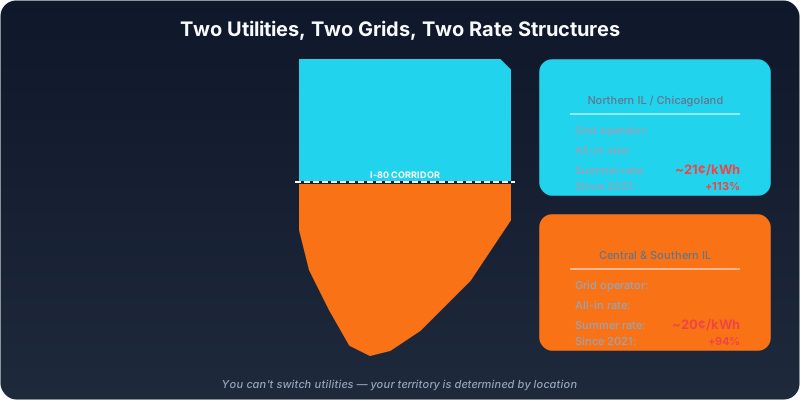
If you live in Illinois, you're on one of two electric utilities: ComEd in the north or Ameren Illinois in the central and southern parts of the state. Both have raised rates dramatically since 2021, but they've done it differently — and one is consistently more expensive than the other depending on when you look.
Here's how they actually compare in 2026, broken down by every component that shows up on your bill.
ComEd vs Ameren: Which Costs More Per kWh?
In the non-summer months (the April 2026 figures below), ComEd is more expensive. But Ameren catches up — and sometimes passes ComEd — during summer months.
Updated September 13, 2026: the figures in this section are the April 2026 non-summer rates. The summer Price to Compare through September 30, 2026 is 11.326¢ for Ameren Illinois and 10.399¢ for ComEd, per the ICC's Plug In Illinois pages.
| Component | ComEd | Ameren Illinois |
|---|---|---|
| Supply rate | 10.8¢/kWh | 8.8¢/kWh |
| Delivery charges | ~6.5¢/kWh | ~4.6¢/kWh |
| Monthly customer charge | $15.50 | $14.51 |
| All-in rate (non-summer) | ~17¢/kWh | ~15.5¢/kWh |
| All-in rate (summer) | ~21¢/kWh | ~20¢/kWh |
| Increase since 2021 | +113% | +94% |
ComEd runs about 1.5¢/kWh higher than Ameren during non-summer months. That gap narrows in summer when Ameren's delivery rates jump sharply.
How Your Bill Is Built
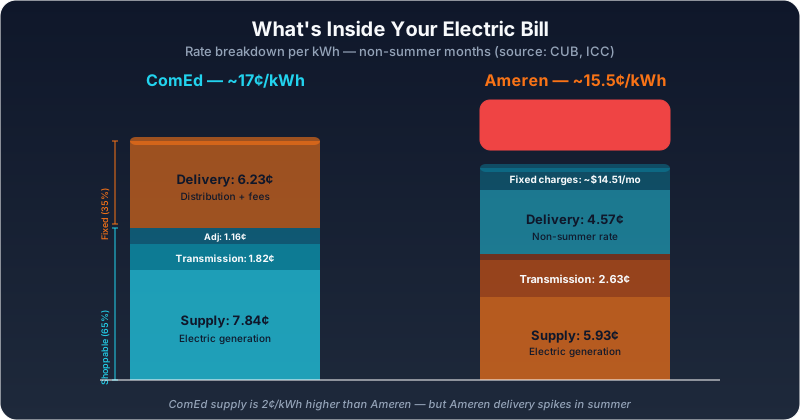
Most people look at one number — the total on the bill. But your rate is actually made up of several components, and ComEd and Ameren structure them differently.
Supply Charges (what the electricity itself costs)
This is the "Price to Compare" — the part you can theoretically shop for with an alternative supplier.
ComEd (April 2026): 10.819¢/kWh
- Electric supply: 7.841¢/kWh
- Transmission: 1.819¢/kWh
- Purchased electricity adjustment: +1.159¢/kWh (changes monthly)
Ameren (April 2026): 8.769¢/kWh (first 800 kWh)
- Electric supply: 5.927¢/kWh
- Transmission: 2.629¢/kWh
- Supply cost adjustment: 0.312¢/kWh
ComEd's supply rate is 2¢/kWh higher than Ameren's. The main reason: ComEd is in PJM territory, where capacity auction prices have been higher than MISO (Ameren's grid operator). The June reset that pushed ComEd's summer Price to Compare to 10.399¢ is covered in full in our ComEd rate increase 2026 breakdown. PJM's 2026-2027 capacity price cleared at $329/MW-day, while MISO's annual average was around $217/MW-day.
Delivery Charges (what the poles and wires cost)
This is the non-shoppable part — you pay it regardless of who supplies your electricity.
ComEd:
- Customer charge: $15.50/month
- Distribution: 6.333¢/kWh (Distribution Facilities Charge, beginning with April 2026 bills) plus a 0.128¢/kWh distribution tax
- Metering: $3.87/month (standard meter)
Ameren:
- Customer charge: $8.55/month
- Meter charge: $5.96/month
- Distribution (non-summer): 4.572¢/kWh (first 800 kWh)
- Distribution (summer): 7.811¢/kWh — jumps 71% in June
This is where Ameren's summer spike comes from. Their delivery rate nearly doubles between May and June. ComEd's delivery rate stays relatively flat year-round.
The Summer Flip
During non-summer months (October-May), ComEd is clearly more expensive. But starting in June, Ameren's delivery charges spike and the gap almost disappears:
| Season | ComEd All-In | Ameren All-In | Difference |
|---|---|---|---|
| Winter (Jan-May) | ~17¢/kWh | ~15.5¢/kWh | ComEd +1.5¢ |
| Summer (Jun-Sep) | ~21¢/kWh | ~20¢/kWh | ComEd +1¢ |
| Peak summer day | ~23¢/kWh | ~22¢/kWh | Nearly even |
In the hottest months, when air conditioning drives usage to 1,200+ kWh, total bills land in the same ballpark — $200-260/month for both utilities.
Why Both Utilities Cost So Much More Than in 2021
Five years ago, both utilities charged around 8¢/kWh all-in. The increases come from different sources but hit at the same time:
Capacity costs — the wholesale price of guaranteeing enough power plants exist to meet peak demand. PJM capacity rose 1,038% in two years. MISO summer capacity rose 2,122% in one year. These costs flow directly into supply rates.
Data centers — Illinois approved 27 data centers that collectively consume 5.43% of statewide electricity. PJM's market monitor attributed 70% ($9.3 billion) of capacity cost increases to data center demand.
Infrastructure investment — both utilities won ICC approval for delivery rate hikes: $243 million for ComEd, $48 million for Ameren. Grid upgrades, aging equipment replacement, and storm hardening all cost money.
Global energy — the Iran conflict has pushed oil to $112/barrel and disrupted global LNG. While Illinois is 53% nuclear (good insulation), the 17% natural gas component still feels the pressure.
What About Alternative Suppliers?
Illinois is a deregulated electricity market. You can choose a different supplier for the "supply" portion of your bill through Plug In Illinois. The delivery charges stay the same regardless.
Should you switch? It depends:
- Fixed-rate plans can lock in your supply cost below the current Price to Compare — useful if you expect rates to keep rising
- But — read the fine print. Many alternative suppliers charge early termination fees, have variable-rate periods after the fixed term, or include hidden charges
- CUB recommends comparing carefully and watching for introductory teaser rates that spike after 3-6 months
The supply portion is typically 55-65% of your total bill. Even if you find a great alternative supplier, you're only shopping that portion — delivery charges stay fixed.
The Solar Equation: How It Changes by Utility
Solar economics actually differ meaningfully between ComEd and Ameren territory:
| Factor | ComEd Territory | Ameren Territory |
|---|---|---|
| Rate you're offsetting | ~17-21¢/kWh | ~15.5-20¢/kWh |
| Grid operator | PJM | MISO |
| Net metering | Supply-rate credit (~6-8¢/kWh) | Supply-rate credit (~6-8¢/kWh) |
| SREC value | Same statewide | Same statewide |
| Avg. sun hours | 4.0-4.2/day | 4.3-4.7/day |
| Solar payback | Faster (higher rate) | Slightly longer |
| 25-year savings | Higher (higher rate) | Still substantial |
ComEd customers actually benefit more from solar in dollar terms because they're offsetting a higher per-kWh rate. But Ameren territory gets slightly more sunshine, which partially compensates.
Either way, both utilities are now expensive enough that solar pays for itself well within the system's lifespan. The question isn't whether solar makes financial sense — it's which option fits your situation:
- $0 down lease — predictable payment, battery included, maintenance covered
- Cash purchase — own the system and maximize savings with Illinois Shines RECs
- Solar for All — income-qualified? Zero cost to you
The Bottom Line
ComEd is more expensive than Ameren by about 1.5¢/kWh in non-summer months. That gap narrows in summer. Both utilities have raised rates dramatically since 2021, and neither expects to come back down anytime soon.
The underlying forces — data center demand, capacity auction prices, infrastructure costs, and now global energy instability — are structural, not cyclical. Your bill trajectory is clear: up.
Solar gives you a way off that escalator. Whether you're in Chicago or Springfield, Naperville or Belleville, the math works.
Check your city's solar savings →
Sources
- Plug In Illinois — Ameren Illinois Price to Compare
- Plug In Illinois — Illinois Commerce Commission supplier and rate information
- Citizens Utility Board — PJM capacity auction leads to price spike for second straight year
- Citizens Utility Board — How data centers are raising our bills in Illinois
- Citizens Utility Board — CUB's report on 2026 electric rates
Ryan Cook is the founder of Ltd Solar Consulting, helping Illinois homeowners across both ComEd and Ameren territory. Get a free quote or call (618) 217-2001.