Data Centers = 70% of Illinois's Rate Spike (Here's What It Costs You)
analysis7 min read

Data Centers = 70% of Illinois's Rate Spike (Here's What It Costs You)

Ryan Cook

I've been getting a version of the same question from customers for months now. They've seen posts on Facebook about how much electricity AI uses. They've watched videos about data centers consuming enough power to run entire cities. And they're connecting the dots — if tech companies keep building these facilities, electric bills are going to keep going up.

They're right. The numbers are worse than most people realize.

70% of the Cost Spike Came From Data Centers

PJM's Independent Market Monitor found that 70% — or $9.3 billion — of last year's capacity cost increase was driven by data center demand. That's not a vague "contributing factor." That's the primary driver, and every residential customer in Illinois is paying for it.

PJM operates the grid for northern Illinois (ComEd territory). MISO operates it for central and southern Illinois (Ameren territory). Both grids are getting squeezed.

On the PJM side, capacity auction prices went from $28.92/MW-day in 2024 to $329.17/MW-day for 2026-2027. That's more than a 1,000% increase in two years. On the MISO side, summer capacity prices jumped from $30 to $666.50/MW-day in a single year — a 22x spike.

Those numbers flow directly into the rate you pay per kilowatt-hour. There's no buffer between the auction and your bill.

How Much Power Are We Talking About?

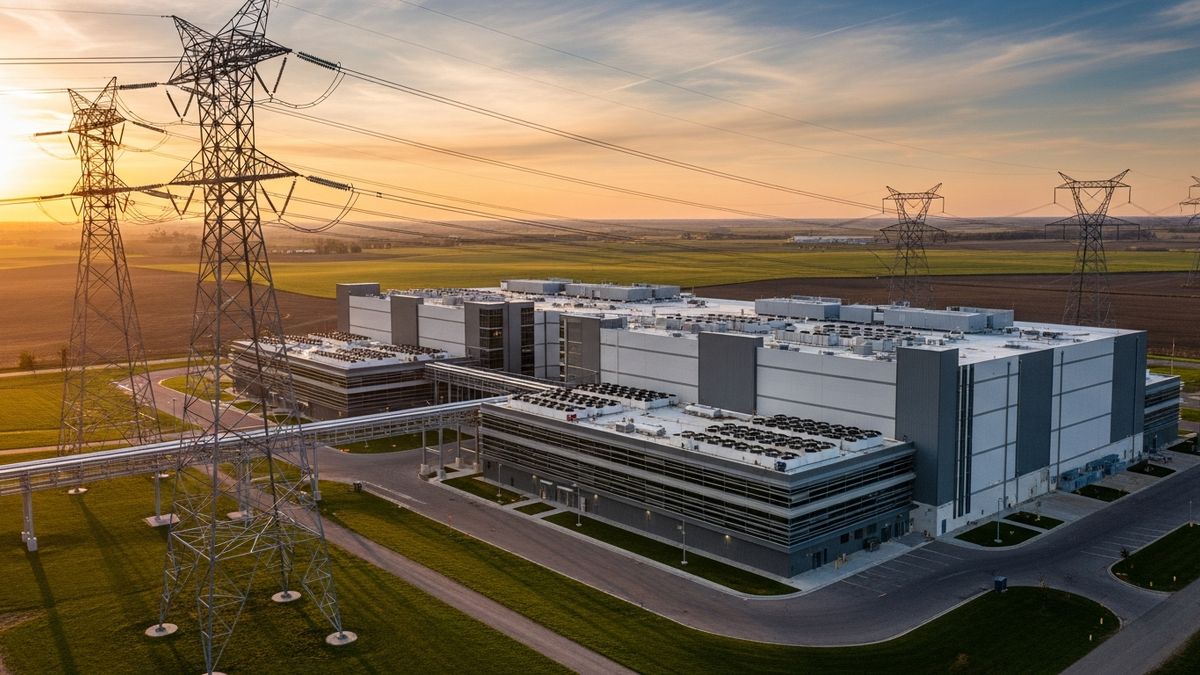
A single large data center can consume 600 megawatts. That's roughly what an entire mid-size city uses. PJM projects that data center demand will add 32 gigawatts of peak load by 2030, and all but 2 gigawatts of that growth comes specifically from data centers.

Illinois already had 30 additional data centers planned as of late 2024. Data centers consumed 5.43% of all electricity in the state by January 2025, and that share is climbing fast.

And these aren't small operations. In Joliet, a $20 billion, 795-acre data center campus would consume up to 1.8 gigawatts — the largest in Illinois. The plan commission voted to advance it despite significant resident backlash. Meta is building a $1 billion facility in DeKalb. Microsoft has campuses going up in Cherry Valley (350 acres, 4-6 buildings) and Hoffman Estates ($500M+). T5 Data Centers is building a 480-megawatt campus in Grayslake. Prime Data Centers broke ground on a $1 billion campus in Elk Grove Village.

If you live near any of these towns, you already know. Residents in Joliet packed public hearings. The city council delayed its vote after a marathon session. People are paying attention.

The Citizens Utility Board warns this trajectory could mean "rolling blackouts and bill spikes by up to $70 a month" within years if nothing changes. NRDC projects $21.4 billion in cumulative capacity costs for ComEd territory alone between 2028 and 2033.

Illinois Is Starting to Push Back

I talk to homeowners across the state — Belleville, Aurora, Champaign, Peoria — and many of them aren't just worried about cost. They're ready to fight to keep data centers out of their communities. The state legislature is hearing them.

The POWER Act (SB2181), introduced by Sen. Ram Villivalam and Rep. Robyn Gabel, would require data centers to pay for their own energy costs instead of passing them to residents. It also mandates renewable energy sourcing, water usage reporting, and community benefit agreements. It has bipartisan support and is currently in committee.

Governor Pritzker announced a two-year suspension of state tax incentives for new data center developments, effective July 1, 2026.

Local governments aren't waiting for Springfield. Aurora enacted a 180-day moratorium on new data center construction and is now drafting ordinances requiring energy, water, and noise impact studies from developers. Champaign County is considering a 12-month moratorium on data centers over 10,000 square feet. McLean County passed zoning rules limiting data centers to manufacturing zones — specifically to protect farmland. Naperville, Yorkville, and Lisle all have data centers on their council agendas.

These are meaningful steps. But they won't undo the capacity costs already locked in from the 2025 and 2026 auctions. Even with reform, elevated rates are here for years.

Where Your Rate Stands Today

ComEd's all-in residential rate sits at approximately 17.07¢/kWh — up 90% from five years ago. Another increase is expected in June 2026 when new capacity costs kick in.

Ameren Illinois customers pay about 15.5¢/kWh on average. That MISO capacity jump to $666.50/MW-day means Ameren's summer rates will be volatile again. And Ameren has already told regulators it plans to file another rate increase request in 2026.

ComEd Ameren IL
Current avg rate ~17¢/kWh ~15.5¢/kWh
5-year increase +90% +94%
Grid operator PJM MISO
Capacity price spike $29 → $329/MW-day $30 → $667/MW-day
Next rate change June 2026 June 2026

Both columns point in the same direction.

The Blackout Question

Cost isn't the only thing keeping people up at night. When you hear "rolling blackouts" from a consumer watchdog like CUB, it hits different.

PJM actually failed to meet its reliability target in the 2027-2028 capacity auction — they couldn't secure enough resources to maintain a 20% reserve margin. MISO's reserve margin dropped from 6.5 GW to 2.6 GW in two years. These aren't hypotheticals. This is the grid telling us it's running out of headroom.

I've noticed more customers asking about battery backup in the last six months than in the previous two years combined. A solar battery system means stored power when the grid goes down. During last summer's heat waves, some ComEd customers lost power for days. A battery keeps your refrigerator running, your sump pump working, and your family comfortable.

Illinois offers a $300/kWh storage rebate through Illinois Shines, which brings the cost down significantly. I did a full breakdown of what batteries actually power and whether they're worth it if this is on your radar.

What You Can Control

You can't stop Meta from building another data center. You can't vote on capacity auction rules. But you can decide where your electricity comes from.

A solar lease starts at approximately $0.10/kWh — roughly 40% less than ComEd and 35% less than Ameren. That rate doesn't move when the next capacity auction breaks another record. It doesn't spike in June.

For homeowners who qualify, Solar for All provides no-cost solar with guaranteed savings — check your eligibility in about 30 seconds.

For everyone else, run your numbers on our Solar Savings Calculator or look up your city on our Illinois solar pages. Every one of our 1,100+ city pages has data specific to your area.

Or call me at (618) 217-2001. I'll tell you what I tell everyone who asks about their bill: the data centers aren't leaving, the grid isn't getting cheaper, and the best time to lock in a lower rate was yesterday.


Sources:

Frequently Asked Questions

Yes — data centers drove approximately 70% of Illinois's capacity cost spike in 2025, which flows directly into higher residential electric bills. PJM's Independent Market Monitor found that $9.3 billion of last year's capacity cost increase came specifically from data center demand in ComEd territory. That share is climbing: data centers consumed 5.43% of all Illinois electricity by January 2025, and PJM projects 32 gigawatts of new peak load by 2030, with all but 2 gigawatts coming from data centers. Illinois had 30 additional data centers planned as of late 2024. A single large facility can consume 600 megawatts — roughly the same as a mid-size city. Both ComEd (PJM grid) and Ameren Illinois (MISO grid) are passing capacity auction costs directly through to residential ratepayers with no buffer, which is why bills have jumped 90%+ in five years.
Citizens Utility Board projections show Illinois households could see bill increases of up to $70 per month within a few years if data center demand continues without intervention, with NRDC estimating $21.4 billion in cumulative capacity costs for ComEd territory alone between 2028 and 2033. The mechanism is the PJM and MISO capacity auctions, which reserve grid capacity years in advance. PJM's clearing price jumped from $28.92 per megawatt-day in 2024 to $329.17 per megawatt-day for 2026-2027 — more than a 1,000% increase in two years. MISO's summer clearing price went from $30 to $666.50 per megawatt-day in a single year, a 22x spike. Those auction results translate directly into the cents-per-kilowatt-hour you pay, which is why ComEd rates sit at approximately 17.07¢/kWh and Ameren Illinois averages 15.5¢/kWh in 2026 — both up over 90% since 2021.
Illinois's largest approved and planned data centers cluster in specific high-capacity corridors: Joliet hosts a $20 billion, 795-acre campus consuming up to 1.8 gigawatts — the state's largest. Meta is building a $1 billion facility in DeKalb. Microsoft has campuses under development in Cherry Valley (350 acres, 4-6 buildings) and Hoffman Estates ($500 million+). T5 Data Centers is constructing a 480-megawatt campus in Grayslake, and Prime Data Centers broke ground on a $1 billion campus in Elk Grove Village. Altogether, Illinois had 30 additional data centers planned as of late 2024. The buildout concentrates in ComEd's PJM grid territory because PJM connects to major Midwest markets, but proposed sites are also appearing in Ameren Illinois (MISO) territory. Residents near these sites have packed public hearings and delayed council votes — data center siting is now one of the most contested local zoning issues in Illinois.
The risk of rolling blackouts in Illinois is real enough that Citizens Utility Board has issued formal warnings — PJM (the grid operator for ComEd territory) actually failed to meet its own reliability target in the 2027-2028 capacity auction, unable to secure enough resources to maintain a 20% reserve margin. On the MISO side, covering Ameren Illinois, the reserve margin dropped from 6.5 gigawatts to 2.6 gigawatts in just two years. These aren't hypothetical scenarios; they are grid operators publicly reporting that headroom is running out. Some ComEd customers already lost power for multiple days during last summer's heat waves. The combination of rapid data center load growth, aging transmission infrastructure, and delayed new generation projects means Illinois residential customers face a higher blackout risk in 2026-2028 than at any point in the past decade. A solar battery system stores power for outages, which is why storage demand has surged.
Illinois is pursuing data center regulation at both state and local levels, though enforcement is still being drafted. The POWER Act (SB2181), introduced by Sen. Ram Villivalam and Rep. Robyn Gabel, would require data centers to pay for their own energy costs instead of passing them to residential customers, mandate renewable sourcing, require water usage reporting, and require community benefit agreements — it has bipartisan support and currently sits in committee. Governor Pritzker announced a two-year suspension of state tax incentives for new data center developments, effective July 1, 2026. Local governments moved faster: Aurora enacted a 180-day construction moratorium; Champaign County is considering a 12-month moratorium on data centers over 10,000 square feet; McLean County passed zoning rules limiting data centers to manufacturing zones. However, these reforms cannot reverse the capacity costs already locked in from the 2025-2026 PJM and MISO auctions, so elevated rates are here for several years regardless.
The most reliable way to insulate your household bill from data center-driven rate increases is to lock in a fixed solar rate that does not move with PJM or MISO capacity auction outcomes. A solar lease in Illinois starts at approximately $0.10/kWh — roughly 40% below current ComEd residential rates and about 35% below Ameren Illinois rates — and that rate stays fixed for 15 years regardless of how high capacity prices go. For income-qualified Illinois households, the Solar for All program (ILSFA) provides no-cost solar installation with guaranteed savings on electricity bills and no credit check required. Adding battery storage offers an additional layer of protection against blackouts, and Illinois Shines offers a $300/kWh storage rebate that significantly reduces the upfront cost. The key concept: ComEd and Ameren rates are tied to volatile auction pricing, while solar rates are fixed by contract once signed.
Illinois electricity rates have risen faster than most peer Midwest states primarily because Illinois sits at the intersection of two grids — PJM (northern Illinois, ComEd) and MISO (central and southern Illinois, Ameren) — that both experienced historic capacity price spikes in 2024 and 2025. PJM's capacity clearing price rose over 1,000% in two years, and MISO's summer capacity price rose 22x in a single year. Both grids carry heavy data center load growth, with Illinois alone projected to add 32 gigawatts of peak demand by 2030. Compared to MidAmerican Energy in the Quad Cities at 12-13¢/kWh or Duke Energy Indiana around 14¢/kWh, Illinois residential rates of approximately 17¢/kWh (ComEd) and 15.5¢/kWh (Ameren) reflect structural grid pressure that Iowa, Missouri, and Indiana customers have not seen to the same degree. The Citizens Utility Board projects these elevated rates will continue through at least 2028.

More Illinois Solar Guides

ComEd Is 1.5¢/kWh More Than Ameren in 2026 — Full Rate BreakdownComEd averages ~17¢/kWh, Ameren Illinois ~15.5¢/kWh. See the full 2026 breakdown: supply charges, delivery fees, summer spikes, and how much it costs per month.Illinois Electricity Rates 2026: What's Coming This Summer (And How to Prepare)Illinois electricity rates are up 47-94% since 2021 — and another spike hits June 2026. Here's exactly what's driving it and how to protect your household.The Iran War Is Sending Oil Prices Through the Roof — Will Your Illinois Electric Bill Follow?Oil is at $112/barrel after the Strait of Hormuz blockade. Here's how the Iran conflict could push Illinois electricity rates even higher — and what you can do now.Why Your Ameren Bill Keeps Going Up (and What MISO Has to Do With It)Ameren bills jumped 18-22% last summer and another increase is coming. Here's why MISO capacity auctions are driving your rates up and what you can do about it.The Real Cost of Solar Panels in Illinois: 2026 BreakdownWhat do solar panels actually cost in Illinois in 2026? Real numbers for cash purchase, lease, and Solar for All — from an installer who gets prices below the state average.What Happens to Your Solar Panels When You Sell Your House in IllinoisSelling a house with solar panels or a lease in Illinois? Here's how the transfer works, what buyers actually think, and why it's not the problem most people expect.Solar Lease vs Buying Panels: I Did the Math for IllinoisShould you lease or buy solar panels in Illinois? I broke down the real numbers for both paths using current 2026 prices, incentives, and Ameren/ComEd rates.ComEd Bills Are About to Spike Again — June 2026 Brings Another Record Capacity CostComEd capacity costs just hit another record — $329/MW-day starting June 2026. Here's what it means for your bill and what you can do about it.Illinois Electricity Rates Have Nearly Doubled Since 2021 — Here's What That Means for Your BillIllinois electricity rates have surged 90%+ since 2021. Here's what's driving the increases, what to expect next, and how to protect your household.Illinois Solar Incentives 2026: 7 Programs Worth $12,000-$18,000+$12,000-$18,000+ in Illinois solar incentives for 2026: Illinois Shines RECs, DG rebate ($300/kW), battery rebate, Solar for All (ILSFA), property tax exemption.Solar Battery Backup in Illinois — What It Actually Powers and Whether It's Worth ItWhat does a solar battery actually run during an outage? How much does it cost with the $300/kWh rebate? Here's the honest breakdown for Illinois homeowners.

41 panels, $10/month electric bills. Ryan stayed on top of the project from start to finish.

Bruce Brooks
Bruce BrooksShiloh, IL

$10/month Ameren bills since June 2023. Outstanding knowledge and responsiveness.

Rod Hinrichs
Rod HinrichsFreeburg, IL

Ryan is knowledgeable, caring, and a really good listener. I highly recommend discussing solar with him.

LH
Linda HaycraftShiloh, IL

Ready to See Your Numbers?

This article covers the big picture. For savings specific to your home, get a free consultation.

Lease, cash, or Solar for All — explore your options

Every month on rising utility rates is money you could be saving.