Illinois Electric Rates Keep Climbing — Does Solar Finally Make Sense in 2026?
analysis5 min read

Illinois Electric Rates Keep Climbing — Does Solar Finally Make Sense in 2026?

Ryan Cook

If your Illinois electric bill made you wince this summer, you're not imagining it, and you're not alone. Both utilities reset rates on June 1, and the new numbers continue a five-year climb that's roughly doubled what we pay. The question I get most isn't "why is this happening" anymore. It's "is this ever going to stop, and what can I actually do about it?"

Let me give you the real picture, a way to see what you're on track to overpay, and an honest answer on whether solar makes sense for you.

The Climb Is Real — Here Are the Numbers

Ameren Illinois ComEd
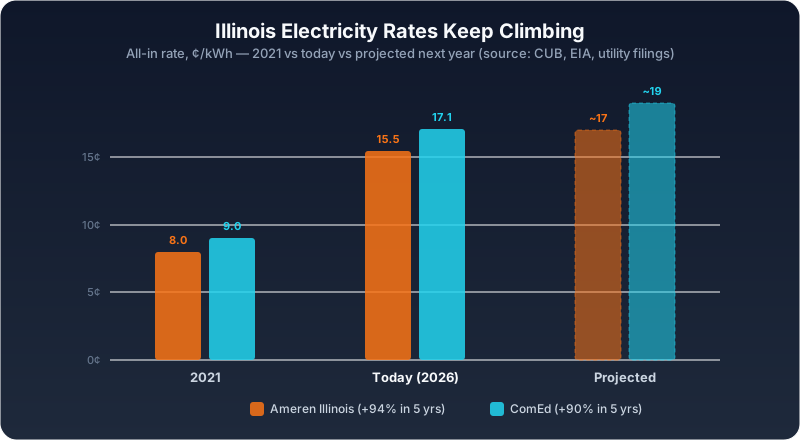
All-in rate today (est.) ~15.5¢/kWh (up to ~20¢ summer) ~17¢/kWh
Rate ~5 years ago ~8¢/kWh ~9¢/kWh
Five-year change +94% +90%
What's next Another rate filing signaled Bills projected +~$70/mo by 2028

Bar chart of Illinois all-in electricity rates in cents per kWh for Ameren and ComEd in 2021, today in 2026, and projected next year, showing increases of about 90 to 94 percent over five years

Sources and full year-by-year history: Ameren rate breakdown · ComEd rate breakdown.

This isn't a one-summer spike. The drivers are structural. Record wholesale capacity auction prices (PJM up over 1,000% in two years, MISO up over 2,000% in one), plus surging demand — PJM's own market monitor pinned about 70% of the capacity cost increase on data centers. The Illinois Power Agency projects capacity shortfalls starting in 2029 for northern Illinois and 2031 for the south. We broke down the June reset in detail in our latest rate analysis.

Translation: the people who set these rates are telling you, in their own filings, that this keeps going.

See What You're On Track to Overpay

Here's the trap with utility bills. We think about them one month at a time, so the compounding hides in plain sight.

A $200 monthly bill isn't a $200 problem. At the kind of increases Illinois has seen for five straight years, that bill compounds into a number over 10 and 15 years that's a lot bigger than simple multiplication suggests. Most people have never added it up.

Add it up.

☀️ Illinois Bill Forecaster — Scroll to the interactive tool at the end of this article. Enter your current monthly bill and utility, and see what you're projected to pay over the next 10–30 years if rates keep climbing at the recent Illinois pace — next to a fixed $0-down solar rate over the same window. The gap is your potential overpayment. Or open it full-screen →

If you'd rather start from your actual bill, that same tool reads your real charges, and the savings calculator shows city-specific solar numbers for your address. No national averages — your figures.

So, Is Solar Worth It?

Honest answer: for most homes with decent roof exposure, the rising-rate trend is the whole reason it works. Solar replaces power you'd otherwise buy at 17–20¢/kWh with electricity from your own roof. So the more rates climb, the more each kilowatt-hour you produce is worth.

You've got three real paths in Illinois:

  1. $0-down lease — fix your rate instead of renting it. Locks in around $0.10/kWh on average for 15 years, battery backup included, no upfront cost. The gap between that fixed rate and the utility widens every time rates rise. How a lease works → or see what one costs per month.
  2. Cash purchase — own it. Adds Illinois SREC payments and decades of low-cost power. It no longer gets the 30% federal homeowner credit, which ended in 2025, but ownership still wins long-term for some buyers.
  3. Solar for All — no cost for income-qualified households, with guaranteed savings built into the program. Check eligibility →

It's not worth it for everyone. A heavily shaded roof or very low usage can change the answer, and I'll tell you straight if it doesn't fit. But high, rising rates tilt the math toward yes for a lot of Illinois homes.

My Take

I've watched this climb for five years now, and the thing that frustrates me is how normal it's become. People budget for the increase like it's weather. Something that just happens to you.

It doesn't have to. The whole point of solar is to stop renting a rate that only goes one direction. You don't have to commit to anything to see the math. Start with the forecaster above, or check your roof in about a minute. If the numbers don't make sense for your home, I'll be the first to tell you. If they do, every summer you wait is the most expensive one yet.

See what solar saves in your city →


Ryan Cook is the founder of Ltd Solar Consulting, helping Illinois homeowners compare solar options across Ameren and ComEd territory. Get a free quote or call (618) 217-2001.

Interactive Tool

See What You're Really On Track to Pay

Enter your bill (or upload it) and watch your projected utility cost over the next 10–30 years — next to a fixed $0-down solar rate. The gap is your potential overpayment.

Upload Your Utility Bill

Upload your Ameren or ComEd bill to see what electricity is costing you — and what it could cost over the next 15 years.

Or Enter Manually

How to find your rate on your bill:

  1. Find “Current Electricity Charges” (the total dollar amount for electricity this period)
  2. Find your total kWh used for the billing period
  3. Divide the charges by the kWh: $charges ÷ kWh = your $/kWh rate
  4. Example: $180 ÷ 1,100 kWh = $0.164/kWh (16.4¢)
Conservative (2%)Historical (4-6%)Aggressive (10%)

Frequently Asked Questions

Two forces are driving it, and neither is going away soon. First, wholesale capacity auctions — the markets that pay power plants to be available — cleared at record prices for 2026–27. PJM, which serves ComEd, jumped over 1,000% in two years; MISO, which serves Ameren, jumped more than 2,000%. Utilities pass those costs straight into the supply portion of your bill. Second, surging electricity demand, especially from data centers; PJM's own market monitor attributed about 70% of the capacity cost spike to data centers. On top of that, both utilities have won delivery rate increases through the Illinois Commerce Commission. The result is an all-in rate around 17¢/kWh for ComEd and up to 20¢/kWh in Ameren's summer — roughly double what Illinois paid in 2021, with more increases already filed.
A lot, and fast. Ameren Illinois rates are up roughly 94% over five years, climbing from around 8¢/kWh in 2021 toward an all-in average near 15.5¢ today, with summer rates hitting about 20¢/kWh. ComEd rates are up roughly 90% over the same period, from around 9¢ to an all-in average near 17¢/kWh. And the climb isn't finished: Ameren has signaled another rate filing, and ComEd customers are projected to see bills rise by around $70 a month by 2028 as capacity and grid costs flow through. These are averages — your actual rate depends on your usage, season, and whether you shop suppliers. But the direction has been one way for five straight years, and the structural drivers point the same way for the next several.
For most homes with decent roof exposure, the rising-rate trend is exactly what makes solar pencil out. Solar replaces grid power you'd otherwise buy at 17–20¢/kWh with electricity produced on your own roof, so the more rates climb, the more each kilowatt-hour you produce is worth. A $0-down lease locks in a fixed rate around $0.10/kWh on average for 15 years — and the gap between that fixed rate and your utility rate widens every time the utility raises prices. A cash purchase adds Illinois SREC payments and decades of low-cost power, though it no longer gets the federal homeowner tax credit that ended in 2025. Income-qualified households may go solar at no cost through Illinois Solar for All. Worth it isn't universal — it depends on your roof and usage — but high rates tilt the math toward yes.
Start with your current monthly bill and project it forward using the trend, not a flat line. If your bill is $200 a month today and rates rise even modestly each year — as they have for five straight years in Illinois — that bill compounds into a far larger number over 10 or 15 years than simple multiplication suggests. A useful exercise is to total what you're on track to pay the utility over the next 15 years at a realistic rate of increase, then compare it to a fixed solar rate over the same window. That gap is your potential overpayment. Our rate tools do this math for your specific bill and utility so you're working with your real numbers, not a national average — and they'll show whether a fixed rate would have come out ahead.
They solve different problems, and you can think of them as short-term versus long-term. Switching to an alternative retail supplier through Plug In Illinois can shave the supply portion of your bill if you find a fixed rate below the utility's Price to Compare — but watch for teaser rates that reset higher, monthly fees, and early termination charges, and remember it never touches delivery charges. Solar addresses the whole structure: instead of shopping for a slightly better rate to rent, you produce your own power and largely step out of the rate-increase cycle. Switching suppliers is a reasonable move while you decide. Solar is the move if you want to stop being exposed to capacity auctions and data center demand altogether. Many homeowners do the first while they evaluate the second.

More Illinois Solar Guides

What Solar Panels Really Cost in Illinois in 2026 (Honest Numbers, No Lead-Selling)What solar panels actually cost in Illinois in 2026 — real per-watt and per-system numbers, what changed this year, and why we don't sell your info to five callers.Illinois Net Metering Changed in 2025 — What It Costs You and How to Protect Your SavingsIllinois ended full retail net metering on Jan 1, 2025. Here's what the switch to net billing actually costs solar owners — and how to protect your savings.The 30% Solar Tax Credit Ended — Here's How Illinois Homeowners Still Get It in 2026The 30% federal tax credit ended for homeowner-owned systems on Dec 31, 2025. Here's how Illinois homeowners can still capture federal solar value in 2026.How Much Does a Solar Lease Cost Per Month in Illinois? (2026)What does a solar lease actually cost per month in Illinois? Real 2026 numbers, what's included, and how a fixed lease rate compares to a rising utility bill.ComEd Is 1.5¢/kWh More Than Ameren in 2026 — Full Rate BreakdownComEd averages ~17¢/kWh, Ameren Illinois ~15.5¢/kWh. See the full 2026 breakdown: supply charges, delivery fees, summer spikes, and how much it costs per month.Ameren Illinois Summer Electric Rates Up June 1: Now 11.3¢/kWhAmeren Illinois summer rates rose June 1, 2026: 11.326¢/kWh Price to Compare. ComEd is now 10.399¢. What your summer bill looks like — and how to cap your rate.The Iran War Is Sending Oil Prices Through the Roof — Will Your Illinois Electric Bill Follow?Oil is at $112/barrel after the Strait of Hormuz blockade. Here's how the Iran conflict could push Illinois electricity rates even higher — and what you can do now.Why Your Ameren Bill Keeps Going Up (and What MISO Has to Do With It)Ameren bills jumped 18-22% last summer and another increase is coming. Here's why MISO capacity auctions are driving your rates up and what you can do about it.The Real Cost of Solar Panels in Illinois: 2026 BreakdownWhat do solar panels actually cost in Illinois in 2026? Real numbers for cash purchase, lease, and Solar for All — from an installer who gets prices below the state average.Selling a House With Solar Panels in Illinois — Leased or OwnedSelling a house with solar panels or a lease in Illinois? Here's how the transfer works, what buyers actually think, and why it's not the problem most people expect.Solar Lease vs Buying Panels: I Did the Math for IllinoisShould you lease or buy solar panels in Illinois? I broke down the real numbers for both paths using current 2026 prices, incentives, and Ameren/ComEd rates.Data Centers = 70% of Illinois's Rate Spike (Here's What It Costs You)Data centers drove 70% of Illinois's capacity-cost spike in 2026. See the PJM/MISO mechanism, the per-household cost impact, and what to do to protect your bill.ComEd's June 2026 Rate Is Live: 10.399¢/kWh — Here's Your New BillComEd's June 2026 rate is official: 10.399¢/kWh Price to Compare, up from ~9.66¢ this winter. See what your new summer bill looks like — and how to cap your rate.Illinois Electricity Rates Have Nearly Doubled Since 2021 — Here's What That Means for Your BillIllinois electricity rates have surged 90%+ since 2021. Here's what's driving the increases, what to expect next, and how to protect your household.Illinois Solar Incentives 2026: 7 Programs Worth $12,000-$18,000+$12,000-$18,000+ in Illinois solar incentives for 2026: Illinois Shines RECs, DG rebate ($300/kW), battery rebate, Solar for All (ILSFA), property tax exemption.Solar Battery Backup in Illinois — What It Actually Powers and Whether It's Worth ItWhat does a solar battery actually run during an outage? How much does it cost with the $300/kWh rebate? Here's the honest breakdown for Illinois homeowners.

41 panels, $10/month electric bills. Ryan stayed on top of the project from start to finish.

Bruce Brooks
Bruce BrooksShiloh, IL

$10/month Ameren bills since June 2023. Outstanding knowledge and responsiveness.

Rod Hinrichs
Rod HinrichsFreeburg, IL

Ryan is knowledgeable, caring, and a really good listener. I highly recommend discussing solar with him.

LH
Linda HaycraftShiloh, IL

Ready to See Your Numbers?

This article covers the big picture. For savings specific to your home, get a free consultation.

Lease, cash, or Solar for All — explore your options

Every month on rising utility rates is money you could be saving.