The 30% Solar Tax Credit Ended — Here's How Illinois Homeowners Still Get It in 2026
guide5 min read

The 30% Solar Tax Credit Ended — Here's How Illinois Homeowners Still Get It in 2026

Ryan Cook

If you've been putting off solar and figured the 30% federal tax credit would always be there, I've got bad news. For systems you buy and own, that credit ended on December 31, 2025.

This question lands in my inbox every week now. Here's the straight version: what actually changed, what didn't, and how an Illinois homeowner can still capture federal solar value in 2026.
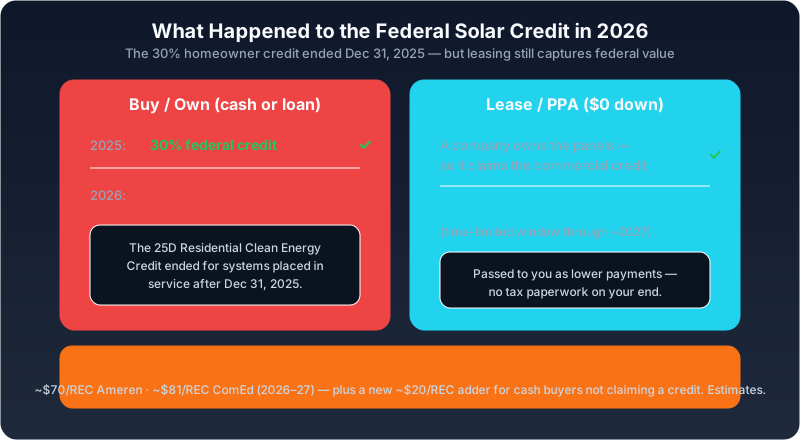
Comparison graphic showing the 30% federal homeowner solar credit ended in 2026 while leased systems still capture federal value, with Illinois Shines intact for both

What Changed: The Homeowner Credit Is Gone

The 30% credit most people know — the Residential Clean Energy Credit, or "25D" — is the one you claimed on your tax return when you paid cash or financed your panels. Under the 2025 federal budget law, it's not available for any system placed in service after December 31, 2025.

In plain terms: if you own the panels and they weren't switched on by the end of last year, there's no 30% federal credit for you in 2026.

That's a real loss, and I won't sugarcoat it. A lot of the cost guides online still quote that old 30% number like it's current. Some of them rank at the top of Google. It isn't current. Anyone telling you a cash system still gets 30% off from the feds this year is working from outdated information.

What Didn't Change: The Part Most Pages Miss

Here's what the panicked headlines leave out. The federal credit for commercial solar — the version a company claims when it owns a system — has a longer runway than the homeowner credit that just expired.

Why does that matter to you? With a lease or power purchase agreement, you don't own the panels. A third-party company does. That company can still claim the commercial credit, and it bakes that value into the price it offers you. You don't file a single tax form. It's a big reason a $0-down lease can still reflect federal incentive savings in 2026, even though the homeowner credit is gone.

Let me be careful here, because this matters. The window is time-limited, and the rules around when a project has to start and qualify get detailed. The value isn't automatic, and it won't last forever. But for a lot of Illinois homeowners, leasing quietly became the smarter way to still capture federal value this year. See how a lease pencils out for your home →

Illinois Still Has Its Own Incentives

Federal isn't the whole picture in Illinois — and our state programs didn't go anywhere.

Illinois Shines still pays you for the renewable energy credits (SRECs) your system produces over 15 years. For the 2026–27 program year, a typical home system earns roughly $70 per REC in Ameren territory and about $81 per REC in ComEd territory, with the customer receiving an estimated 85% of that value. On a normal-sized roof, that's thousands of dollars over the contract. Here's the full breakdown of how Illinois Shines works.

There's also a detail almost nobody's talking about yet. The 2026–27 program added a customer-owned adder worth about $20 per REC for cash or financed systems that don't claim the federal credit. Since the homeowner credit just ended, far more cash buyers now qualify for that adder automatically. It doesn't replace the 30% credit. But it softens the blow, and you won't see it on the national cost pages. Estimate your REC value here →

And if money's tight, Illinois Solar for All offers solar at no cost to income-qualified households, with guaranteed savings built into the program. Check if you qualify →

My Take

The end of the 30% homeowner credit isn't the end of solar in Illinois — it's a shift in which path makes the most sense.

A year ago I was running the numbers for a lot of cash buyers, because the 30% credit made ownership hard to beat. These days I'm having more lease conversations. The lease is where the federal value still lives. That's not a sales line. It's just where the policy moved the math.

Meanwhile the other side of the equation keeps getting stronger. Illinois rates are up roughly 90% in five years and still climbing. Every month you wait, the gap between a fixed solar rate and your utility bill gets wider. If a lease is where your head's at, here's what one actually costs per month in Illinois. See what solar saves in your city →

If you started this research thinking you'd missed the boat, you didn't. You just need the 2026 version of the math, not the 2024 version. For the bigger picture on every Illinois incentive still on the table, read our complete 2026 incentives guide.


Ryan Cook is the founder of Ltd Solar Consulting, helping Illinois homeowners compare solar options across Ameren and ComEd territory. Want the 2026 numbers for your home? Get a free quote or call (618) 217-2001.

Interactive Tool

Estimate Your Illinois Shines REC Value

See what your system could earn through Illinois Shines for the 2026–27 program year, by size and utility territory.

New 2026-2027 Price Updates

Official Illinois Shines Guidebook prices just published. Cash and finance buyers now qualify for an extra +$20/REC Small DG Customer-Owned adder (Small DG ≤25 kW, no federal tax credit claimed).

Most IL homes: 5–10 kW

3h (Chicago)4.8h (Southern IL)

Estimated REC Value (85% to customer)

$11,347

50% paid in your first year, remaining 50% quarterly over 6 years • Cash/finance buyers receive directly

How this is calculated

Illinois Shines measures value in RECs (Renewable Energy Credits). 1 REC = 1,000 kWh of solar production. More sunlight and more panels means more production — and a higher REC value.

1
Annual Production7.5 kW × 3.8 sun hrs × 365 days

10,403 kWh/year

2
Annual RECs10,403 kWh ÷ 1,000

10.4 RECs/year

3
Total 15-Year RECs10.4 × 14.2 (contract multiplier)

147.7 RECs

4
Gross REC Value147.7 RECs × $90.37/REC

$13,350

Tier: 0–10 kWAmeren IL territory • 2026-2027 program year

+$20/REC Customer-Owned Adder applied ($70.37 base + $20.00 adder)

5
Estimated Customer REC Value$13,350 × 85%

$11,347

~15% goes to approved vendor admin fee + 5% collateral for underproduction

Tier note: Your 7.5 kW system falls in the 0–10 kW tier at $70.37/REC base. Systems over 10 kW drop to the 10–25 kW tier at $60.92/REC — a lower per-REC rate, though more total production may offset this.

Estimates based on 2026-2027 IL Shines Distributed Generation REC prices published by the Illinois Power Agency. Actual REC value depends on your system's measured production, which varies by roof orientation, shading, and panel efficiency. Lease customers benefit from RECs through lower payments — the installer claims the RECs and carries the 15-year production contract.

Get Your Estimated REC Value — Free Quote

We'll calculate your specific value based on your roof, shading, and optimal system size.

Frequently Asked Questions

Yes — for systems you buy and own. The Residential Clean Energy Credit, also called the 25D credit, was the 30% federal tax credit homeowners claimed when they paid cash or financed their panels. Under the 2025 federal budget law, it is not available for any system placed in service after December 31, 2025. If your solar panels were not turned on and operating by the end of 2025, you cannot claim the 30% credit on a system you own in 2026. This is the biggest change to home solar incentives in over a decade, and most online guides still show the old 30% number. The credit for homeowner-owned systems is genuinely gone — but as we explain below, that is not the whole story for Illinois, where leasing and the state's SREC program still carry real value.
Not directly — but you can still benefit from it. With a lease or power purchase agreement, a third-party company owns the panels on your roof, not you. Because that company owns the system, it can still claim the federal commercial solar credit, which has a longer runway than the homeowner credit that ended in 2025. The company factors that federal value into the price it offers you, which is part of why a $0-down lease can still reflect federal incentive savings in 2026. You do not file any tax paperwork yourself. This window is time-limited and the rules are detailed, so the value depends on when a project starts and qualifies. That is exactly why timing matters this year — and why a quick estimate from us beats guessing.
Quite a few, actually. Illinois Shines still pays for the renewable energy credits your panels produce over 15 years, and for the 2026–27 program year that runs roughly $70 per REC in Ameren territory and about $81 per REC in ComEd territory for a typical home system. There is also a new customer-owned adder worth about $20 per REC for cash or financed systems that do not claim the federal credit — and since the homeowner credit ended, more buyers now qualify for it. Income-qualified households may go solar at no cost through Illinois Solar for All. And leasing still captures federal value indirectly through the company that owns the system. So while the 30% homeowner credit is gone, an Illinois homeowner in 2026 still has real incentives to work with.
No. The math changed, but it did not collapse. Illinois electricity rates have climbed roughly 90% in five years and keep rising, so the savings side of the equation keeps getting stronger even as the federal credit fades. A $0-down lease locks in a fixed rate around $0.10 per kWh on average while utility rates keep climbing, and it still reflects federal value through the company that owns the panels. Cash buyers lose the 30% credit but gain the new customer-owned SREC adder and still get 15 years of REC payments. Income-qualified homeowners may pay nothing at all. The right move depends on your roof, your usage, and your goals — which is why we start every conversation with a free, no-pressure estimate rather than a sales pitch.
For a lot of Illinois homeowners, leasing got relatively more attractive in 2026, because the lease still captures federal value while a cash purchase no longer can. A $0-down lease means no large upfront check, a fixed rate for 15 years, and battery backup included, with savings that widen as utility rates rise. A cash purchase still makes sense if you want to own the system outright, value the long-term return, and want the SREC payments plus the new customer-owned adder — you just won't have the 30% credit softening the upfront cost anymore. There is no single right answer; it depends on whether you'd rather avoid upfront cost or maximize long-term ownership. Both paths beat doing nothing while your utility bill keeps climbing.

More Illinois Solar Guides

What Solar Panels Really Cost in Illinois in 2026 (Honest Numbers, No Lead-Selling)What solar panels actually cost in Illinois in 2026 — real per-watt and per-system numbers, what changed this year, and why we don't sell your info to five callers.Illinois Electric Rates Keep Climbing — Does Solar Finally Make Sense in 2026?Ameren and ComEd rates are up ~90% in five years and still climbing. Here's how to see what you're on track to overpay — and whether solar finally makes sense.Illinois Net Metering Changed in 2025 — What It Costs You and How to Protect Your SavingsIllinois ended full retail net metering on Jan 1, 2025. Here's what the switch to net billing actually costs solar owners — and how to protect your savings.How Much Does a Solar Lease Cost Per Month in Illinois? (2026)What does a solar lease actually cost per month in Illinois? Real 2026 numbers, what's included, and how a fixed lease rate compares to a rising utility bill.ComEd Is 1.5¢/kWh More Than Ameren in 2026 — Full Rate BreakdownComEd averages ~17¢/kWh, Ameren Illinois ~15.5¢/kWh. See the full 2026 breakdown: supply charges, delivery fees, summer spikes, and how much it costs per month.Ameren Illinois Summer Electric Rates Up June 1: Now 11.3¢/kWhAmeren Illinois summer rates rose June 1, 2026: 11.326¢/kWh Price to Compare. ComEd is now 10.399¢. What your summer bill looks like — and how to cap your rate.The Iran War Is Sending Oil Prices Through the Roof — Will Your Illinois Electric Bill Follow?Oil is at $112/barrel after the Strait of Hormuz blockade. Here's how the Iran conflict could push Illinois electricity rates even higher — and what you can do now.Why Your Ameren Bill Keeps Going Up (and What MISO Has to Do With It)Ameren bills jumped 18-22% last summer and another increase is coming. Here's why MISO capacity auctions are driving your rates up and what you can do about it.The Real Cost of Solar Panels in Illinois: 2026 BreakdownWhat do solar panels actually cost in Illinois in 2026? Real numbers for cash purchase, lease, and Solar for All — from an installer who gets prices below the state average.Selling a House With Solar Panels in Illinois — Leased or OwnedSelling a house with solar panels or a lease in Illinois? Here's how the transfer works, what buyers actually think, and why it's not the problem most people expect.Solar Lease vs Buying Panels: I Did the Math for IllinoisShould you lease or buy solar panels in Illinois? I broke down the real numbers for both paths using current 2026 prices, incentives, and Ameren/ComEd rates.Data Centers = 70% of Illinois's Rate Spike (Here's What It Costs You)Data centers drove 70% of Illinois's capacity-cost spike in 2026. See the PJM/MISO mechanism, the per-household cost impact, and what to do to protect your bill.ComEd's June 2026 Rate Is Live: 10.399¢/kWh — Here's Your New BillComEd's June 2026 rate is official: 10.399¢/kWh Price to Compare, up from ~9.66¢ this winter. See what your new summer bill looks like — and how to cap your rate.Illinois Electricity Rates Have Nearly Doubled Since 2021 — Here's What That Means for Your BillIllinois electricity rates have surged 90%+ since 2021. Here's what's driving the increases, what to expect next, and how to protect your household.Illinois Solar Incentives 2026: 7 Programs Worth $12,000-$18,000+$12,000-$18,000+ in Illinois solar incentives for 2026: Illinois Shines RECs, DG rebate ($300/kW), battery rebate, Solar for All (ILSFA), property tax exemption.Solar Battery Backup in Illinois — What It Actually Powers and Whether It's Worth ItWhat does a solar battery actually run during an outage? How much does it cost with the $300/kWh rebate? Here's the honest breakdown for Illinois homeowners.

41 panels, $10/month electric bills. Ryan stayed on top of the project from start to finish.

Bruce Brooks
Bruce BrooksShiloh, IL

$10/month Ameren bills since June 2023. Outstanding knowledge and responsiveness.

Rod Hinrichs
Rod HinrichsFreeburg, IL

Ryan is knowledgeable, caring, and a really good listener. I highly recommend discussing solar with him.

LH
Linda HaycraftShiloh, IL

Ready to See Your Numbers?

This article covers the big picture. For savings specific to your home, get a free consultation.

Lease, cash, or Solar for All — explore your options

Every month on rising utility rates is money you could be saving.