Illinois Will Help Churches, Food Pantries, and Libraries Go Solar — Applications Open August 3
If you sit on the board of a church, a food pantry, a library, or any nonprofit in Illinois, here's a date to circle: August 3, 2026, at 9 a.m. That's when Illinois Solar for All opens its project submission window for the Non-Profit and Public Facilities sub-program — the state's path for putting solar on the buildings that serve low-income communities, with the program's own rules capping what the organization pays.
The announcement went up on the program's site July 27. Most people will never see it, because it lives on a vendor-facing announcements page that nobody outside the industry reads. But if your organization's electric bill competes with your actual mission for dollars every month, this is worth ten minutes of your attention.
What exactly opened
Updated September 13, 2026: the 2026–27 Non-Profit and Public Facilities window described below ran August 3–14, 2026 and has closed. The single-family (Residential Solar Small) window runs September 14–25, 2026.
Illinois Solar for All (ILSFA) is the state's income-qualified solar program, and it runs on submission windows. Approved Vendors — solar companies vetted by the Illinois Power Agency — submit projects during a window, and those projects compete for that program year's funding. The residential windows get most of the attention. This one is different: it's specifically for non-profits and public facilities, and the program's exact words are that the window "opens on August 3, 2026, at 9 a.m."
I watch this program closely, and the 2026-27 year has been rolling out in stages all summer: income thresholds in June, budgets late June, the apartment-building window in July. Nonprofits are next in line. The window for single-family homes was announced afterward (it runs September 14–25, 2026), which tells you something about where the program is putting its early energy this year.
Who actually qualifies — it's not every nonprofit
This is where I'd rather be straight with you than get your hopes up. The program has three tests, and all of them are quoted from its own eligibility page:
- Location. Your organization must be "located in or adjacent to and serving residents of an ILSFA-designated environmental justice or income-eligible community." That covers more of Illinois than people assume — much of East St. Louis, Decatur, Rockford, Peoria, Cairo, and parts of nearly every mid-sized city downstate — but it is a real map with real boundaries.
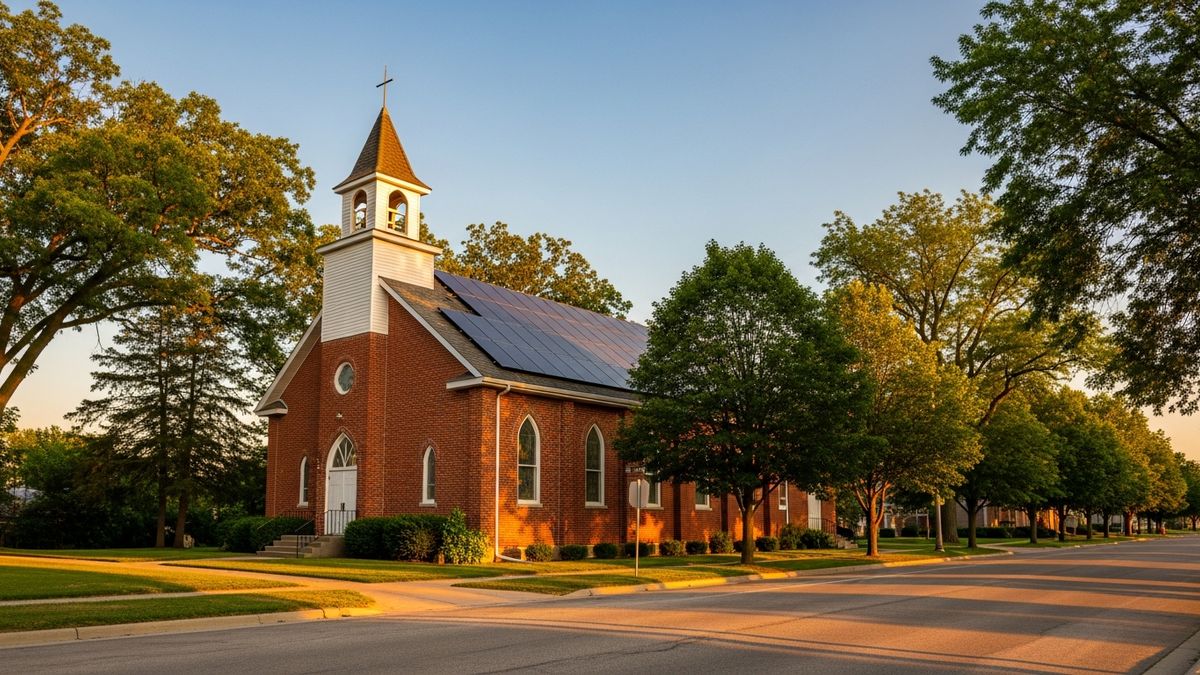
- Mission. You need to "operate as a non-profit or public entity that provides critical services," and the program's own examples are "hospitals, houses of worship, senior centers, food pantries, or libraries." A public facility also qualifies if it "hosts a department or agency that is a critical service provider" — think a township building or a county health department.
- Engagement. The program requires organizations to "demonstrate community engagement." If your building is already a place people come to for help, you're most of the way there.
A booster club with a storage shed isn't getting funded. A food pantry in Decatur with a flat roof and a painful Ameren Illinois bill is exactly who this was built for.
What it costs — the 50% rule
Here's the part that makes this program worth writing about. ILSFA's pages say participating organizations face "no or low upfront costs" — and for ongoing payments, the cap is a program rule, not a sales pitch: "Ongoing fees will not exceed 50% of the value of the electricity generated by the solar project, ensuring savings."
The program's own worked example: a system producing 1,000 kWh a month, at a 10-cent rate, cuts about $100 a month off the electric bill — roughly $1,200 a year. Under the cap, payments in that scenario could never exceed $600 a year. The gap is the organization's to keep. Your actual numbers depend on your roof, your usage, and your rate, and I'll always tell you those are estimates until a real design exists.
There are three ways to structure it: buy the system outright, lease it, or sign a power purchase agreement where a third party owns the panels on your roof and sells you the power. The 50% cap applies to the lease and PPA paths. On the purchase path, there's a federal wrinkle worth knowing: tax-exempt organizations can now access certain federal credits through a mechanism called elective pay — the Illinois Power Agency hosted a webinar on exactly that in June. That's an accountant conversation, but it's a real one.
Two protections apply either way, in the program's words: Approved Vendors "must present a standard Disclosure Form before you sign a contract or any work can begin," and the program "has a 14-day cancellation period without penalties."
Why the date matters
ILSFA money does not sit on the table. The residential side of this program hit capacity in 2025 and told qualifying homeowners to wait for new funding. The apartment-building window that ran in July 2026 was open for eleven days. When a window opens, Approved Vendors submit the projects that are ready — and "ready" means the eligibility check, the utility bills, the roof assessment, and the vendor relationship all happened before the window opened.
August 3 is when submissions start. It is not when planning should start. That's six days from the day I'm writing this.
Where I fit in
I'm a solar consultant in Belleville and a registered Designee with the state's programs — not an Approved Vendor, which means my job is the part before the paperwork: figuring out whether your building and your address actually qualify, what a system could realistically do for your bill, and which path (purchase, lease, or PPA) fits how your organization operates. Then the right vendor carries the submission.
If you help run a nonprofit or public facility anywhere in Central or Southern Illinois and you've ever winced at the electric bill, reach out or call (618) 217-2001. The eligibility check costs nothing, and if you don't qualify, I'll tell you that too — there are other Illinois solar programs and even community solar options where an organization can participate as an anchor subscriber for up to 40% of a project.
Every number above comes from the program's own pages, and every savings figure is an estimate until a design exists for your building. But the window date is not an estimate. August 3, 9 a.m.