ComEd & Ameren Want Another Rate Hike — CUB Found $1 Billion in Questionable Spending
news5 min read

ComEd & Ameren Want Another Rate Hike — CUB Found $1 Billion in Questionable Spending

Ryan Cook

Your electric bill jumped on June 1. Both utilities are already lining up the next increase.

ComEd filed a $15.3 billion four-year grid plan in January — a 21% spending increase over its current plan. Ameren Illinois filed its own four-year plan for central and southern Illinois. And last week, the Citizens Utility Board (CUB) told state regulators it found more than $1 billion of questionable spending in ComEd's request, plus hundreds of millions more in Ameren's.

I've been selling solar in Illinois for five years, and I've watched this cycle repeat: supply prices spike, everyone talks about it for a month, and meanwhile the quieter delivery-rate cases grind through the Illinois Commerce Commission and lock in increases for years. This is one of those quiet ones. Here's what's actually on the table.

The $930 Million Year

CUB tallied up every pending rate-hike request from Illinois' biggest utilities and hit $930 million in 2026 alone. For ComEd and Ameren electric customers, it breaks down into two waves:

Wave 1 — the "reconciliation" hikes (2026 cases). ComEd wants an extra $234 million and Ameren an extra $65 million in delivery charges — $299 million combined. Reconciliation cases true-up what the utilities say they actually spent versus what regulators approved. The ICC typically rules on these near year-end.

Wave 2 — the four-year grid plans (2028 and beyond). The ICC already approved rate plans for both utilities through 2027. The new filings set delivery rates for the next four-year cycle. ComEd's ask is $15.3 billion. That's the one where CUB's experts found over $1 billion they call questionable, and hundreds of millions more in Ameren's plan.

Here's the whole picture in one table:

What's pending ComEd Ameren IL Who decides, and when
2026 "reconciliation" delivery hike $234M $65M ICC ruling expected near year-end 2026
Four-year grid plan (sets 2028+ delivery rates) $15.3B ask Multi-billion 4-yr plan ICC ruling after hearings
Spending CUB calls questionable $1B+ ~$300M CUB testimony filed 6/29 — ICC weighs it

One more number from CUB worth sitting with: the parent companies of these utilities took in about $15 billion in profits in 2025.

Why This Stings More Than a Normal Rate Case

Because it stacks on top of a summer that already hurt.

On June 1, ComEd's Price to Compare reset to 10.399¢/kWh and Ameren's summer rate hit 11.326¢/kWh — driven by record capacity auctions and data center demand. We broke that down in our June rate-spike post. All-in, a typical household is paying an estimated 17¢/kWh in ComEd territory and 20¢/kWh in Ameren territory this summer.

That June spike was the supply side of your bill. These new cases target the delivery side — the charges you pay no matter who supplies your electricity. Supply prices can ease when auctions cool off. Delivery increases, once approved, are baked in for years.
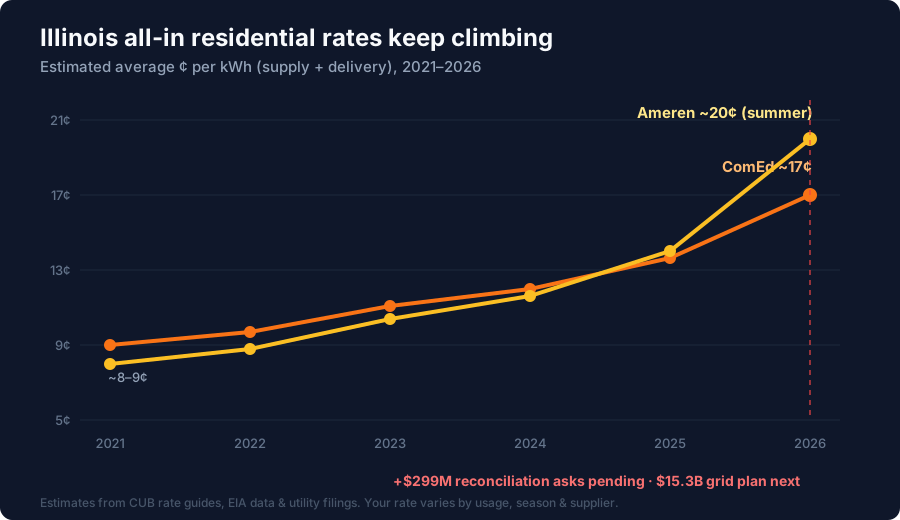
Chart: estimated Illinois all-in residential electric rates climbing from about 8–9 cents per kWh in 2021 to roughly 17 cents (ComEd) and 20 cents summer (Ameren) in 2026, with pending rate cases marked

My take: the delivery cases are where Illinois households lose ground slowly and permanently. Nobody notices a reconciliation docket. Everybody notices five years later that their "cheap" winter rate isn't cheap anymore. ComEd's average residential rate is up roughly 90% over five years; Ameren's is up about 94%. The trajectory didn't happen by accident — it happened one approved case at a time.

What Happens Next

The ICC will take CUB's testimony, the utilities' rebuttals, and months of hearings before ruling. Two things are worth knowing:

  1. The commission has cut these before. The last round of grid plans got trimmed substantially after pushback from CUB and the Illinois attorney general. The $15.3 billion number is an opening bid, not a done deal.
  2. You can weigh in. CUB is collecting signatures on petitions to the ICC — one for ComEd customers and one for Ameren customers. It costs nothing and the ICC does read public comments.

Realistically, though, some increase is coming. The grid genuinely needs investment, data center load keeps growing, and neither utility has ever filed a plan to charge less.

The Part of Your Bill You Actually Control

You can't vote down a rate case by yourself, and you can't opt out of delivery charges. What you can control is how many kilowatt-hours you buy through the grid in the first place.

That's the whole argument for rooftop solar in Illinois right now — not ideology, just arithmetic. Power from your own roof is power you don't buy at 17–20¢. Three paths, depending on your situation:

  • $0-down lease — a fixed rate as low as $0.10/kWh for 15 years, battery included. Every rate case the ICC approves widens the gap between that number and the utility's.
  • Cash purchase — pairs with Illinois SREC payments, with payback typically estimated around 8–10 years and low-cost power for decades after.
  • Illinois Solar for All — income-qualified households may qualify for solar at no cost through the state program.

All of it starts with your actual roof and your actual usage — every savings figure is an estimate until we look at both. Run your address through our free savings calculator, check the year-by-year history on our ComEd and Ameren rate pages, or just call me at (618) 217-2001. You can also reach us through the contact page — Ryan or a member of the team will reach out ASAP with a call.

The utilities have their four-year plan. It's worth having one of your own.

Interactive Tool

See What You're Really On Track to Pay

Enter your bill (or upload it) and watch your projected utility cost over the next 10–30 years — next to a fixed $0-down solar rate. The gap is your potential overpayment.

Upload Your Utility Bill

Upload your Ameren or ComEd bill to see what electricity is costing you — and what it could cost over the next 15 years.

Or Enter Manually

How to find your rate on your bill:

  1. Find “Current Electricity Charges” (the total dollar amount for electricity this period)
  2. Find your total kWh used for the billing period
  3. Divide the charges by the kWh: $charges ÷ kWh = your $/kWh rate
  4. Example: $180 ÷ 1,100 kWh = $0.164/kWh (16.4¢)
Conservative (2%)Historical (4-6%)Aggressive (10%)

Frequently Asked Questions

Between the two utilities, the Citizens Utility Board counts about $930 million in new rate-hike requests in 2026 alone. The biggest piece is ComEd's $15.3 billion four-year grid plan, filed in January 2026 — a 21% spending increase over its current plan. Ameren Illinois filed its own four-year grid plan for central and southern Illinois. On top of those, both utilities filed extra 'reconciliation' delivery hikes this year: $234 million for ComEd and $65 million for Ameren, about $299 million combined. None of these numbers are final — the Illinois Commerce Commission reviews every request and historically trims them. But the direction is clear. These filings target the delivery portion of your bill, which is separate from the supply-price spike that already hit on June 1, 2026. Delivery charges apply no matter which electricity supplier you choose.
In stages. The 'reconciliation' delivery increases — $234 million for ComEd and $65 million for Ameren — are 2026 cases, so those dollars would show up on bills after the Illinois Commerce Commission rules, typically around the end of the year. The four-year grid plans are the bigger, slower wave: the ICC has already approved rate plans for both utilities through 2027, so the new filings would set delivery rates for the following four-year cycle, starting in 2028. That's why this matters even though your bill already jumped this summer. The June 1, 2026 increase came from record capacity auctions on the supply side. These new requests stack a delivery increase on top of that, for years. Estimates vary by household, but a typical ComEd bill has been projected to rise roughly $70 per month by 2028 if current trends hold.
The Citizens Utility Board filed expert testimony with the Illinois Commerce Commission in late June 2026 saying it found more than $1 billion of questionable spending in ComEd's proposed $15.3 billion grid plan, and hundreds of millions more — roughly $300 million by news accounts — in Ameren Illinois' plan. CUB's argument is that the utilities should cut wasteful or poorly justified projects before asking customers to pay more, especially in a year when supply prices already spiked. CUB also points out that the parent companies of Illinois' biggest utilities earned about $15 billion in total profits in 2025. CUB has petitions urging the ICC to hold both companies accountable, and the commission will weigh that testimony before approving, trimming, or rejecting the plans. Watchdog pressure has worked before — the ICC cut ComEd's and Ameren's last grid-plan requests substantially.
You can't opt out of delivery charges — they apply to every customer in ComEd or Ameren territory, even if you switch to an alternative supplier. But you can shrink the number of kilowatt-hours those charges and supply rates apply to. Efficiency helps at the margins: LED lighting, smart thermostats, and sealing air leaks. Solar makes the bigger dent, because power produced on your roof is power you don't buy through the grid at an estimated 17–20¢ per kWh all-in. A $0-down solar lease locks in a fixed rate as low as $0.10/kWh for 15 years, a cash purchase pairs with Illinois SREC payments, and income-qualified households may get solar at no cost through Illinois Solar for All. Every projection is an estimate based on your roof and usage — our free calculator shows city-specific numbers, or call (618) 217-2001.

More Illinois Solar Guides

Illinois Will Help Churches, Food Pantries, and Libraries Go Solar — Applications Open August 3Illinois Solar for All opens its Non-Profit and Public Facilities window August 3, 2026. Who qualifies, what it costs, and why the date matters.Your Illinois Electric Rate Drops October 1 — Why Your Bill Won't Drop as MuchIllinois summer supply rates expire September 30. Ameren's fell 31% last October — but supply is only half your bill. Here's what actually drops.Can You Rent Solar Panels in Illinois? What Actually Exists in 2026There's no such thing as renting solar panels in Illinois. But there is Community Solar — a state-vetted subscription that gets you bill credits without any equipment. Here's how it actually works.Do Solar Panels Increase Your Property Taxes in Illinois? (2026)Adding solar raises your home's value — so will your property taxes jump too? In Illinois, no. The state's special solar assessment keeps that value off your tax bill.New Illinois Solar for All Income Limits (2026): $97,200 for a Cook County Family of FourIllinois Solar for All raised its income limits on June 1, 2026. A family of four can earn $97,200 in Cook County and still qualify. Here are the county numbers.Will Illinois Have Rolling Blackouts? What ComEd's 'Critical Level' Alerts Mean (2026)ComEd told parts of Chicagoland the grid hit a 'critical level' during the July heat wave. Here's the honest answer on rolling blackout risk in Illinois — and what you can control.Freedom Forever Filed for Bankruptcy — What Illinois Solar Customers Should Do NowFreedom Forever filed Chapter 11 in April 2026. If your Illinois solar system is installed, unfinished, or under quote — here's exactly what to do next.What Solar Panels Really Cost in Illinois in 2026 (Honest Numbers, No Lead-Selling)What solar panels actually cost in Illinois in 2026 — real per-watt and per-system numbers, what changed this year, and why we don't sell your info to five callers.Illinois Electric Rates Keep Climbing — Does Solar Finally Make Sense in 2026?Ameren and ComEd rates are up ~90% in five years and still climbing. Here's how to see what you're on track to overpay — and whether solar finally makes sense.Illinois Net Metering Changed in 2025 — What It Costs You and How to Protect Your SavingsIllinois ended full retail net metering on Jan 1, 2025. Here's what the switch to net billing actually costs solar owners — and how to protect your savings.The 30% Solar Tax Credit Ended — Here's How Illinois Homeowners Still Get It in 2026The 30% federal tax credit ended for homeowner-owned systems on Dec 31, 2025. Here's how Illinois homeowners can still capture federal solar value in 2026.How Much Does a Solar Lease Cost Per Month in Illinois? (2026)What does a solar lease actually cost per month in Illinois? Real 2026 numbers, what's included, and how a fixed lease rate compares to a rising utility bill.ComEd Is 1.5¢/kWh More Than Ameren in 2026 — Full Rate BreakdownComEd averages ~17¢/kWh, Ameren Illinois ~15.5¢/kWh. See the full 2026 breakdown: supply charges, delivery fees, summer spikes, and how much it costs per month.Ameren & ComEd Summer Rates Rose June 1, 2026: 11.3¢ & 10.4¢/kWhUpdated July 2026: Ameren Illinois' summer Price to Compare is 11.326¢/kWh and ComEd's is 10.399¢. See the average Illinois electric rate now, why bills jumped June 1, and how to cap your rate.The Iran War Is Sending Oil Prices Through the Roof — Will Your Illinois Electric Bill Follow?Oil is at $112/barrel after the Strait of Hormuz blockade. Here's how the Iran conflict could push Illinois electricity rates even higher — and what you can do now.Why Your Ameren Bill Keeps Going Up (and What MISO Has to Do With It)Ameren bills jumped 18-22% last summer and another increase is coming. Here's why MISO capacity auctions are driving your rates up and what you can do about it.The Real Cost of Solar Panels in Illinois: 2026 BreakdownWhat do solar panels actually cost in Illinois in 2026? Real numbers for cash purchase, lease, and Solar for All — from an installer who gets prices below the state average.Selling a House With Leased Solar Panels in Illinois (2026 Guide)Selling a house with leased solar panels in Illinois? Here's how the lease transfer works, what buyers actually think, and why it's not the problem most people expect — owned systems too.Solar Lease vs Buying Panels: I Did the Math for IllinoisShould you lease or buy solar panels in Illinois? I broke down the real numbers for both paths using current 2026 prices, incentives, and Ameren/ComEd rates.Data Centers = 70% of Illinois's Rate Spike (Here's What It Costs You)Data centers drove 70% of Illinois's capacity-cost spike in 2026. See the PJM/MISO mechanism, the per-household cost impact, and what to do to protect your bill.ComEd Rate Increase 2026: Current Rate Is 10.399¢/kWh — Your New BillComEd's 2026 rate increase is in effect: the current Price to Compare is 10.399¢/kWh, up from ~9.66¢ this winter. See what your new summer bill looks like — and how to cap your rate.Illinois Electricity Rates Have Nearly Doubled Since 2021 — Here's What That Means for Your BillIllinois electricity rates have surged 90%+ since 2021. Here's what's driving the increases, what to expect next, and how to protect your household.Illinois Solar Incentives 2026: 7 Programs Worth $12,000-$18,000+Illinois solar incentives 2026: Illinois Shines RECs, the new $20/REC customer-owned adder, $300/kW DG rebate, battery rebate, net metering, and property tax exemption — worth $12,000-$18,000+ on an owned system. Plus no-cost Solar for All for income-eligible households.Solar Battery Backup in Illinois — What It Actually Powers and Whether It's Worth ItWhat does a solar battery actually run during an outage? How much does it cost with the $300/kWh rebate? Here's the honest breakdown for Illinois homeowners.

41 panels, $10/month electric bills. Ryan stayed on top of the project from start to finish.

Bruce Brooks
Bruce BrooksShiloh, IL

$10/month Ameren bills since June 2023. Outstanding knowledge and responsiveness.

Rod Hinrichs
Rod HinrichsFreeburg, IL

Ryan is knowledgeable, caring, and a really good listener. I highly recommend discussing solar with him.

LH
Linda HaycraftShiloh, IL

Ready to See Your Numbers?

This article covers the big picture. For savings specific to your home, get a free consultation.

Lease, cash, or Solar for All — explore your options

Every month on rising utility rates is money you could be saving.