Illinois Bought 600 MW of Grid Batteries (It Wanted 1,038) — When Does Your Bill Feel It?
The Illinois Power Agency took bids on August 26 for its first-ever energy storage procurement — a target of 1,038 megawatts of grid-scale battery capacity. On September 1, the Illinois Commerce Commission approved the results: five projects, 600 megawatts, all in Illinois. Contracts were expected to be signed around September 4. It's the first concrete purchase under the Clean and Reliable Grid Affordability Act (CRGA), which the legislature passed in October 2025 and Governor Pritzker signed on January 8, 2026 — and it's the opening move toward the law's target of 3,000 megawatts of storage committed by the end of 2030.
Illinois did something last week that no state program has done here before: it went shopping for a gigawatt of batteries. It came home with a little more than half of one.
The state's own estimate for what CRGA delivers: $13.4 billion in combined savings for Illinois energy customers over the next 20 years, per an IPA finding cited by the governor's office.
That's a big number. Let me tell you what I think it actually means for your bill — because the honest version is more useful than the press-release version.
Who won, and where (updated September 2)
Four of the five winning projects sit in Ameren Illinois territory, in the MISO grid zone that covers central and southern Illinois:
- Gatehouse Energy Storage — 185 MW near Du Bois, in Washington County
- McDuff Battery Storage — 135 MW near Casey, in Clark County
- KCE IL 1 — 100 MW near Flora, in Clay County
- KCE IL 2 — 100 MW near Herrick, in Shelby County
That's 520 MW on the Ameren side against a 450 MW target — the rules let the IPA go over by up to 50% if the last project pushes it there. The ComEd side was the opposite story: one project, Lincoln Reserve Energy at 80 MW in Calumet City, against a 588 MW target. The ICC lists the winning strike price at $110.52 per megawatt-hour for every project, on 20-year contracts.
Two things I take from that. First, southern Illinois is where the batteries are going — Du Bois, Flora, Herrick, and Casey are all small towns in the southern half of the state, the kind of places that already host wind and solar farms. Second, the ComEd shortfall isn't a lack of interest; it's the PJM interconnection queue. Getting a project approved to plug into that grid takes years, and the state can't speed that up by writing a law. The IPA says more rounds come in 2027 and possibly 2028, with a stakeholder feedback request this fall to figure out why the first one came up 438 MW short.
What a battery does for your bill
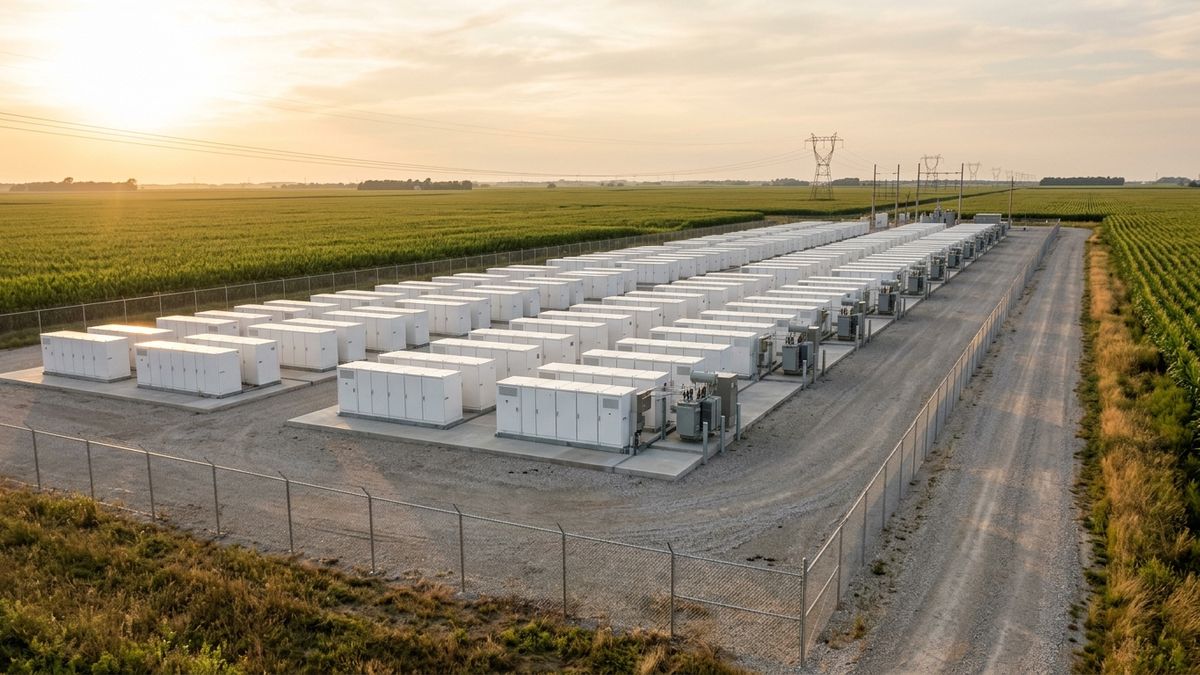
Six hundred megawatts of four-hour batteries is a lot. For scale, that's roughly one large gas-fired power plant's worth of peak output. These batteries won't generate anything — they'll charge when electricity is cheap and plentiful, then discharge during the expensive evening peaks when the grid is strained.
That timing matters more than it sounds. The single biggest reason Ameren bills keep climbing — and ComEd bills with them — is capacity costs: the price utilities pay to make sure enough power is available at peak. Both regional grid operators saw capacity auction prices spike over the last two years, largely because data centers are eating Illinois' power supply faster than anyone is building new plants.
Batteries attack that specific problem. A battery that reliably shows up at peak counts toward capacity just like a power plant does, and utility-scale batteries are among the fastest resources you can build. The contracts require these five to be running by December 31, 2029 — with a one-year extension available if a developer posts more collateral.
The honest math on $13.4 billion
I sell solar for a living, so I spend a lot of time translating big energy numbers into what a family in Belleville or Springfield actually pays. Here's my translation.
$13.4 billion over 20 years is roughly $670 million a year — and that's the estimate for the whole state, split among millions of residential, commercial, and industrial customers, across all of CRGA's programs, not just this battery buy. Per household, my back-of-the-envelope estimate lands at a few dollars a month once everything is running. Real money, worth having. Not a bill cut you'd notice on its own.
There's also a wrinkle in how these contracts pay out. That $110.52 strike price isn't a flat fee. It's an index: on days when the batteries earn more than that in the wholesale market, the developer pays the difference back to the utility; on days they earn less, ratepayers top it up. So what this actually costs you depends on how PJM and MISO prices move over the next 20 years. If capacity stays expensive, the batteries pay for themselves. If it collapses, we cover the gap.
The bigger value is what doesn't happen. Without new capacity, the auction prices that jumped in 2025 and 2026 keep climbing, and your supply rate climbs with them. The batteries are less a discount and more a brake.
One date worth knowing: those capacity costs reset on the utility calendar, which is why supply rates change every June and October. The storage program is trying to bend that curve — starting around the end of 2029.
What this doesn't do
It doesn't touch your bill this year. The ICC signed off September 1; contracts get executed a few days later; then developers spend two to three years siting, permitting, and building. Nothing about your September bill changes because of this announcement.
It also doesn't replace anything you'd do at your own house. The state's batteries hold down costs for everyone, a little. Panels on your roof change one bill — yours — a lot. Those two things aren't in competition, and I've watched people use "the state is fixing it" as a reason to wait on decisions that would have paid for themselves in the meantime.
And to be clear about what happens if the program stumbles: the money is spent through procurements like this one, awarded competitively. This round came up 438 MW short of its target, and the answer is simply another round in 2027. The 3,000-megawatt target is a marathon with checkpoints, not a single bet.
What you can control while the grid catches up
The grid-scale story runs on a 2029 clock. Your bill runs on a monthly one. Between now and then, three things move your number:
Your usage. Peak-hour habits still matter, especially on time-of-day style rates — and CRGA requires both utilities to offer time-of-use pricing, so watch for that option.
Your supply rate. Check what you're actually paying per kilowatt-hour against the utility's default rate. If a marketer signed you up years ago, you may be paying more than you should.
Your own generation. This is the one with real weight behind it. Rate increases are the reason solar math keeps improving — every hike raises the value of a kilowatt-hour you produce yourself. And you don't need cash up front to get there: most Illinois solar leases are priced on what the system produces, as low as $0.10 per kilowatt-hour, which is well under what either utility charges for delivered power today. If backup power is what draws you to the battery story, home batteries are their own decision with their own math.
I'll update this post as the contracts get signed and as the 2027 round takes shape. In the meantime, if you want to know what your own roof could do about your own bill, run your address through our savings calculator or get in touch — or call (618) 217-2001. The state's batteries arrive at the end of 2029. Your solar could be producing by Thanksgiving.