How Big a Battery Do You Need to Run a House in Illinois? A Sizing Guide With Real 2026 Numbers
An average Illinois home uses about 693 kWh a month, which is roughly 23 kWh a day, according to the U.S. Energy Information Administration's 2024 figures. That single number answers most of the battery question. One 13.5 kWh battery runs the basics through a night. Two batteries, about 27 kWh, cover a normal day without air conditioning. Whole-home backup with central air in July takes 27 kWh or more and an inverter that can start the compressor. Everything in this guide is an estimate until we look at your actual bill, but the method below is how I size batteries for real customers from Belleville to Peoria.
I wrote earlier about what a battery actually powers during an outage. This is the follow-up people kept asking for: how do you know which size is yours?
The Two Numbers That Matter
A battery has a tank and an engine. The tank is kilowatt-hours (kWh), how much energy it holds, which sets how long you can run things. The engine is kilowatts (kW), how much it can put out at once, which sets what you can run at the same time.
People fixate on the tank and forget the engine. A battery with 13.5 kWh and a weak inverter will hold plenty of energy and still trip when the air conditioner kicks on. A big inverter on a small tank starts everything and dies before midnight. You need both sized to your house.
| Battery (2025 datasheets) | Tank (usable energy) | Engine (continuous output) | Motor start | Stacks to |
|---|---|---|---|---|
| Tesla Powerwall 3 | 13.5 kWh | up to 11.5 kW (5.8 to 11.5 kW depending on configuration) | 185 LRA | 4 Powerwall 3 units + 3 Expansion units (7 total) |
| Tesla Powerwall 3 Expansion | 13.5 kWh (adds tank only) | uses the Powerwall's inverter | n/a | up to 3 per Powerwall 3 |
| Enphase IQ Battery 5P | 5.0 kWh | 3.84 kVA (7.68 kVA peak) | pair units for motors | multiple units per system |
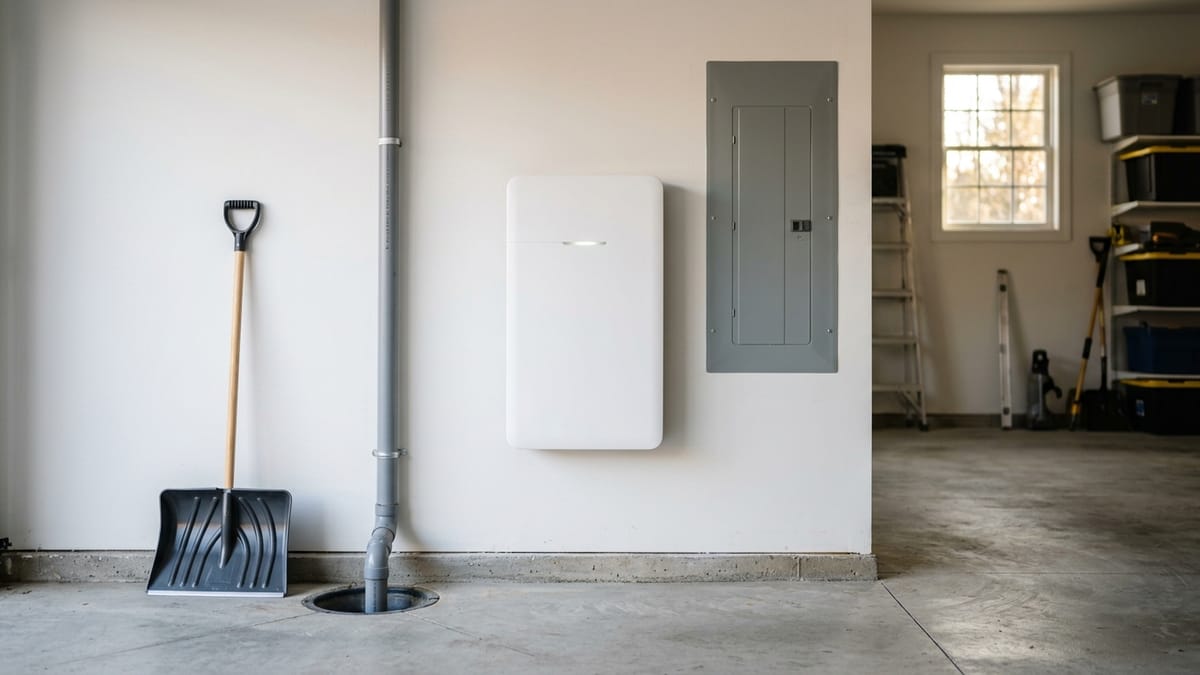
Those are the two products I see most on Illinois roofs. The Powerwall is one big tank with a big engine. The Enphase is a small tank with a small engine that you buy in multiples, which suits a house that only needs the basics kept alive.
Start With Your Bill, Not a Calculator
Every sizing calculator online asks you to list your appliances. Skip that step for a minute. Your utility already measured your house for you.
Pull a recent Ameren Illinois or ComEd bill and find the kWh used for the month. Divide by 30. That is your average daily consumption, and it is a more honest number than any appliance list, because it includes the stuff you forget, like the well pump and the garage freezer.
| Monthly kWh on your bill | Daily use (estimate) | One 13.5 kWh battery covers | Two (27 kWh) cover |
|---|---|---|---|
| 450 kWh (small home, gas heat) | 15 kWh | most of a full day | a full day with margin |
| 693 kWh (Illinois average, EIA 2024) | 23 kWh | a night plus morning | a full day |
| 1,000 kWh (larger home, some electric heat) | 33 kWh | a night of the basics | most of a day |
| 1,500 kWh (electric heat or a July with central air) | 50 kWh | the basics only | a night with AC, then discipline |
Where I've seen this break down is seasonality. Illinois summers are brutal on that monthly number, and the July 2026 heat pushed a lot of August bills past 1,200 kWh. Look at a July bill and a shoulder-month bill and size for the one you actually want to survive.
If you want to understand every line of that bill first, I broke down the Ameren bill line by line and the ComEd delivery charge in earlier posts.
What the Big Loads Actually Draw
The appliance list comes second, because it tells you where the daily kWh goes and what to shut off in an outage. These per-hour figures come from the Silicon Valley Power appliance chart, a municipal utility's published reference, unless marked as my estimate.
| Load | Draw while running | What it means for a 13.5 kWh battery |
|---|---|---|
| Central air, 3 ton (12 SEER) | 3.0 kWh per hour | Four to five hours of continuous cooling empties it |
| Window AC, 8,000 BTU | 0.73 kWh per hour | Overnight in one bedroom is roughly 6 kWh |
| Electric oven | 2.3 kWh per hour | One hour of baking is 17% of the tank |
| Clothes dryer | 2.5 to 4 kWh per load | One heavy load is up to 30% of the tank |
| Electric water heater | 380 to 500 kWh per month (13 to 17 kWh a day) | The single biggest reason whole-home backup needs two batteries |
| Portable space heater, 1,500 W | 1.5 kWh per hour | Nine hours empties it |
| Refrigerator, ENERGY STAR 19 to 25 cu. ft. | 39 to 63 kWh per month (about 1.3 to 2 kWh a day) | Trivial; runs for days |
| Microwave | 0.12 kWh per 5 minutes | Trivial |
| Laptop | 0.02 to 0.05 kWh per hour | Trivial |
| LED bulb, 60 W equivalent | 0.015 kWh per hour | Ten bulbs for six hours is under 1 kWh |
| Gas furnace blower (my estimate) | a few hundred watts while running | An estimated 2 to 4 kWh over a cold night |
| Sump pump, 1/3 hp (my estimate) | under 1 kW, runs a minute or two at a time | An estimated 1 to 2 kWh on a wet night, but watch the starting surge |
Read that table from the top. The first six rows are the loads that decide your size. Everything below the water heater is noise. A house that shuts off the oven, the dryer, the electric water heater, and the central air during an outage can run for a very long time on one battery. A house that insists on all four needs a system that costs real money.
The Three Sizes I Actually Quote
The basics for one night: 13.5 kWh, or two Enphase 5P units. Refrigerator, freezer, internet, lights, phones, the furnace blower, the sump pump, a TV. My estimate for that bundle is 5 to 8 kWh over a 12-hour night, so a 13.5 kWh battery wakes up with half a tank and the panels top it off in the morning. This is the right size for most gas-heated homes in Springfield and Champaign, and it is what comes standard with the leases I sell.
A normal day without cooling: 27 kWh. Two Powerwall 3 units, or one Powerwall 3 with an Expansion, covers the Illinois-average 23 kWh a day with a cushion. You can cook, run the washer, and forget the outage is happening, as long as the central air stays off. Larger homes and homes with electric water heating start here.
Whole home with central air in July: 27 to 40 kWh and a big engine. Three tons of cooling at 3 kWh per hour, running half the afternoon, is 15 to 20 kWh by dinnertime on top of everything else. That is two to three Powerwall-class units, and the inverter has to start the compressor, which is where that 185 LRA figure on the Tesla datasheet earns its keep. It is a real product for a real need, but I want customers to see the number before they say "just back up everything."
The Illinois-Specific Parts
Outages here are short, and that changes the math. The EIA's 2024 reliability data puts the average Illinois customer at 158 minutes without power for the year including major storms, and 59 minutes without them. The national average was 663 minutes. Most Illinois outages are an evening, not a week. Size for a night of comfort and a morning of solar recharge, not for a three-day blackout, unless you are on a rural Ameren feeder that you know goes down for days in ice storms. I cover the grid-reliability picture, and why the rolling blackout headlines get overstated, in a separate post.
Winter is the season that tests the design. A gas furnace needs the blower, a sump pump needs its surge, and your panels are producing a fraction of their June output. I wrote up how far Illinois solar production drops in fall and winter; the short version is that a battery that refilled by 10 a.m. in July may not refill at all on a gray January day. That argues for a bigger tank in winter-outage country, and for shutting off anything with a heating element the moment the power drops.
Electric heat is a different conversation. The Silicon Valley Power chart puts an electric furnace at 10.5 kWh per hour with the fan running and heat-pump backup strips at 10 kWh per hour. No residential battery runs that through a January night. If your heat is electric resistance, size the battery for the basics and plan on a wood stove or a generator for warmth.
What Each Size Costs in Illinois Right Now
Both ComEd and Ameren Illinois pay $300 per kWh of storage capacity through their Distributed Generation rebate, a figure state law sets through December 31, 2029. On a 13.5 kWh battery that is about $4,050. On 27 kWh it is about $8,100. Against installed prices that in my experience run $12,000 to $16,000 per battery before the rebate, a cash buyer lands somewhere around $8,000 to $12,000 for one and roughly double for two, as an estimate. The federal residential credit no longer applies to anything placed in service after December 31, 2025, so that utility rebate is the main discount left.
The rebate comes with strings, and they differ by utility. ComEd requires enrollment in one of its time-varying rate products and participation in its Scheduled Dispatch Virtual Power Plant for the required term, which state law sets at five years; Ameren requires the battery to be charged by an on-site renewable generator, such as your solar panels, and ends delivery-charge crediting for customers who were on net metering before January 1, 2025 and take a rebate on their generator. I laid all of that out in the battery rebate breakdown, and I would read it before signing anything.
On a 25-year solar lease, the battery is part of the package instead of a purchase. One battery adds about $45 a month and a second adds about $25 more, for roughly $70 total. The company that owns the equipment collects the rebate in that case, which is the trade you make for a predictable rate as low as $0.10/kWh and no upfront check. Whether that beats buying depends on your usage, and I will run both against your bill.
My Take
Size the tank off your bill, size the engine off your biggest motor, and shut off the heating elements when the grid drops. Do that and one 13.5 kWh battery handles the outage most Illinois families will actually experience. Go to 27 kWh if you have electric water heating, a big house, or a rural feeder that stays down for days. Go bigger than that only if summer air conditioning on battery is something you have decided is worth paying for.
The mistake I see most is buying for the worst week of the decade and paying for it every month. The second most common mistake is buying the smallest thing and finding out on a March night that the sump pump won't start. The bill-first method above avoids both.
Check Your Own Numbers
Run your monthly kWh through the savings calculator to see how a battery changes a lease or purchase quote, or call me at (618) 217-2001 with a bill in hand. Ten minutes is enough to tell you whether you're a one-battery house or a two-battery house, and I'll show you which loads got you there. You can also send a bill through the contact page and I'll size it from that.
Sources
- EIA Table 5.A, 2024 Average Monthly Bill, Residential — U.S. Energy Information Administration, Form EIA-861 data for 2024 (Illinois: 693 kWh per month, 15.87¢/kWh, $109.99)
- EIA Electric Power Annual, Table 11.4, Reliability Metrics by State — U.S. Energy Information Administration, 2024 SAIDI (Illinois 158.0 minutes with major event days, 59.1 without; U.S. 662.6 / 131.6)
- Powerwall 3 Datasheet, North America — Tesla, 2025 (13.5 kWh, 11.5 kW continuous, 185 LRA, up to 4 units plus 3 Expansion units)
- IQ Battery 5P North America Data Sheet — Enphase Energy, May 2025 (5.0 kWh usable, 3.84 kVA continuous, 7.68 kVA peak)
- Appliance Energy Use Chart — Silicon Valley Power (City of Santa Clara municipal utility), accessed September 17, 2026
- ComEd Distributed Generation Rebates — ComEd, $300 per kWh storage rebate and program conditions
- Ameren Illinois Customer-Owned Solar, Rebates — Ameren Illinois, $300 per kWh storage rebate and eligibility
- 220 ILCS 5/16-107.6, distributed generation rebates — Illinois Compiled Statutes ($300 per kWh of nameplate capacity through December 31, 2029; five-year scheduled dispatch enrollment)
- Residential Clean Energy Credit — IRS, not available for property placed in service after December 31, 2025