FERC Rejected PJM's Data Center Fix. Can Illinois's POWER Act Protect Your Bill?
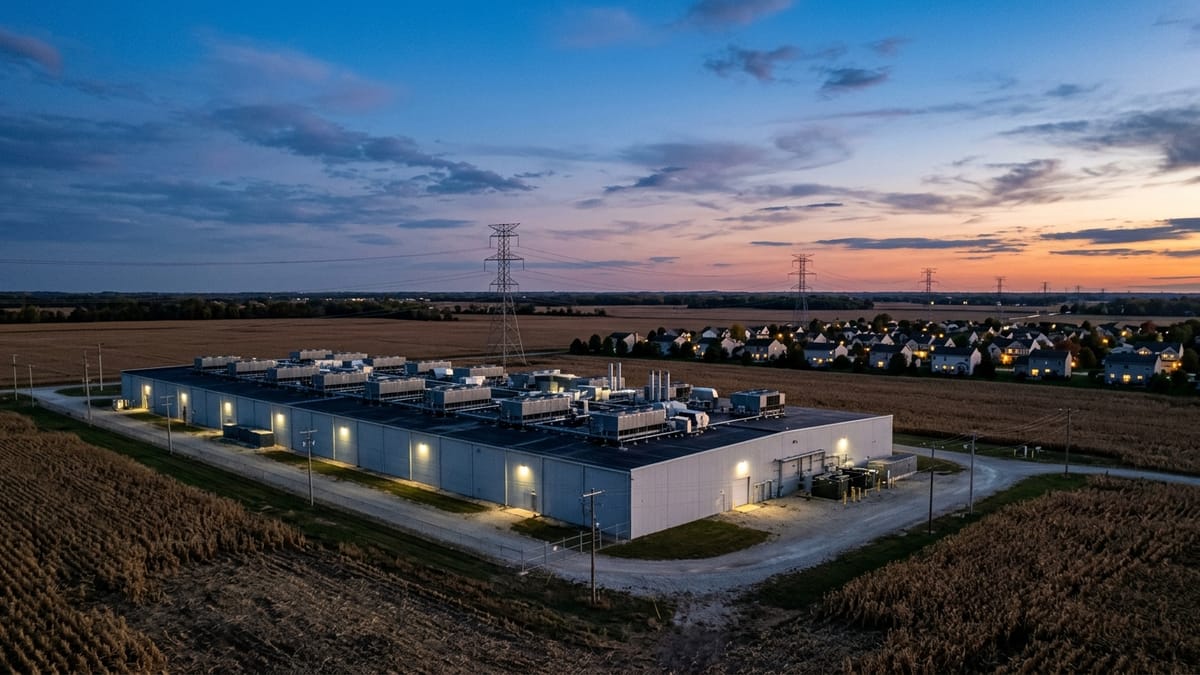
FERC said no. On October 9, 2026, the Federal Energy Regulatory Commission rejected most of PJM's plan to make new data centers bring their own power or get cut off first in a grid emergency. It kept only a 50-megawatt definition of a "large load" and a registry to track them. That leaves the question of who pays for data centers' power with the states. In Illinois, the answer runs through House Bill 5513 and Senate Bill 4016, which backers call the POWER Act. Neither has passed, and the next chance is the fall veto session, November 17–19 and December 1–3.
If you're a ComEd customer, this matters because PJM's capacity auction is one of the fastest-growing pieces of your bill, and the next one runs in December. Here's what happened, what the Illinois bill would actually do, and what you can do while Springfield sorts it out.
The short version
| What | Status | Source |
|---|---|---|
| FERC order on PJM's large-load plan | Accepted the 50 MW definition and Large Load Registry (effective Oct. 12, 2026). Rejected the rest | FERC Docket ER26-3515-000, issued Oct. 9, 2026 |
| PJM's own warning | Short of capacity starting the 2027/2028 delivery year, "particularly due to data center load growth" | Same order, summarizing PJM's filing |
| Next PJM capacity auction | 2029/2030 auction set to run in December 2026 | Same order |
| PJM capacity prices already locked | $329.17 (2026-27), $333.44 (2027-28), $325 (2028-29) per MW-day, up from $28.92 in 2024-25 | PJM auction results |
| Illinois POWER Act (HB 5513 / SB 4016) | Not passed. HB 5513 in House Rules since Mar. 27, 2026. SB 4016 in Senate Assignments since May 22, 2026 | ilga.gov bill status |
| Fall veto session days | Nov. 17, 18, 19 and Dec. 1, 2, 3, 2026 | Illinois Senate 2026 veto calendar |
| State data center tax breaks | New agreements paused starting July 1, 2026 | Governor's office, June 5, 2026 |
| ComEd price to compare | 10.103¢/kWh, Oct. 1, 2026 – May 31, 2027 | Plug In Illinois |
What PJM asked for, and what FERC threw out
PJM runs the grid for northern Illinois. In August it told FERC it'll be short of the power plants it needs starting in the 2027/2028 delivery year, and it blamed data centers. Its fix had a few moving parts.
New data centers could plug in before there was enough generation to cover them. In exchange, they'd be first in line to be cut off in an emergency. Utilities serving them could avoid that by bringing new capacity of their own. And starting with the 2029/2030 delivery year, those new data centers would be left out of the demand curve PJM uses to decide how much capacity to buy at auction.
FERC rejected all of that. The order says the core pieces are "either outside of the Commission's authority or have not been sufficiently demonstrated to be just and reasonable." The commission added: "We do not take this decision lightly." It kept only the 50 MW definition and the registry, and it gave PJM guidance in case it wants to refile.
The detail that matters for your bill is the demand-curve piece. Because it was rejected, new data center demand still counts when PJM sets how much capacity to buy. PJM itself blames data center growth for the capacity shortfall behind the jump from $28.92 to the $325–$333 range. Unless PJM refiles and wins approval in time, the December auction runs without that change.
My honest take: some of FERC's legal reasoning makes sense. Deciding which retail customers get cut off has always been a state job. But the practical effect is that nobody at the federal level is going to make data centers carry their own weight this winter.
What the Illinois POWER Act would actually do
I read the bill. The introduced version of HB 5513 runs 638 pages, so here are the parts that touch your electric bill.
- Who it covers: "hyperscale" data centers, defined as facilities with demand over 50,000 kilowatts (50 MW) in the past 12 months or forecast for the next 12.
- Special rates: within 90 days of the law taking effect, every Illinois electric utility would file a data center tariff. The cost of serving them, including high-voltage lines above 100 kilovolts, would be "allocated to those customers and are not socialized to other rate classes."
- Protection if a project walks away: minimum charges, minimum contract lengths, collateral, and exit fees "to mitigate the risk of stranded costs for other customers."
- Bring your own power: data centers would connect on a nonfirm basis, meaning they can be curtailed, for any load not backed by new capacity they bring themselves. They'd earn firm service as they add it.
- An annual fee: $2 million a year for 50–99.9 MW, rising in steps to $12 million for 1,000 MW or more, paid into a Hyperscale Data Center Public Benefits and Affordability Fund.
- A deadline for regulators: the Illinois Commerce Commission would have up to 240 days to approve, reject, or modify each utility's tariff.
Notice what that list is. It's the state version of what PJM tried and FERC refused. FERC said retail rules belong to the states, and this bill is a state writing retail rules.
There's one more piece solar homeowners will like. Tucked inside the same bill is the Residential Automated Solar Permitting Platform Act. It would require counties and towns to adopt instant online permitting for home solar by July 1, 2027. A town that already issues residential solar permits in person within 5 business days would be exempt. Permits can add weeks to an install in some towns, so that part would help regardless of the data center fight.
Will it lower your bill?
Not the bill you're paying now. Here's why I'd keep your expectations realistic.
First, the auctions that already cleared stay cleared. PJM's capacity prices through May 2029 are set, and no state law reopens them. Second, even a fast bill takes time. If it passed in the veto session, the 90-day filing window plus up to 240 days at the ICC adds up to as much as roughly 11 months after the law takes effect before the first data center tariff is in place. Third, whatever passes will likely be amended. Governor Pritzker's June 5 framework asks lawmakers to "assign the costs that data centers impose on the electric grid to the new data center rate class," and a narrower bill aimed at that would be my guess. That's a guess, not a forecast.
What the bill can do is keep the next round of data center costs off household bills. That's worth something, and it's why the Illinois Clean Jobs Coalition introduced it. My data centers and your electric bill breakdown covers how much of the recent spike traces to data center demand, and my PJM auction post shows why the capacity piece won't fall soon.
If you're an Ameren customer
FERC's order doesn't reach you directly. Central and southern Illinois are on MISO, a different grid operator. MISO's 2025-26 auction cleared at $666.50 per megawatt-day for summer, and the 2026-27 auction cleared at $424.30 for summer 2026. My Ameren and MISO post walks through that side.
The state bill is a different story. As introduced, it applies to "all electric utilities in the State," so Ameren would file a data center tariff too. Downstate, the veto session matters more to you than anything FERC does.
What you can control while Springfield decides
You don't get a vote at FERC, and the veto session is weeks away. What you can decide is how much of your power comes from the grid at all.
For reference, ComEd's price to compare is 10.103¢ per kWh through May 31, 2027, and the estimated all-in rate with delivery runs around 16¢ this winter. Ameren's price to compare is 10.441¢ for the first 800 kWh and 8.262¢ above that through May 2027. Check yours on my ComEd rates and Ameren rates pages, or see what's driving it in why your ComEd bill is so high.
A solar lease in Illinois can start at a predictable rate as low as $0.10 per kWh, with $0 down and a 25-year term. Your full 25-year rate schedule is set in your contract before you sign, so it doesn't swing when the next auction clears. If you'd rather own, I'll price a cash system next to it. For income-qualified households, Illinois Solar for All offers "guaranteed savings with no solar payment & reduced utility bills," which is the program's own language.
Run your numbers on the savings calculator, or call me at (618) 217-2001. I'm a local installer working with trusted Illinois partners, and I'll show you lease, cash, and Solar for All side by side. I'll also post an update here after the veto session.
Sources
- FERC order accepting in part and rejecting in part PJM's large load tariff revisions, Docket ER26-3515-000, 197 FERC ¶ 61,019 (Oct. 9, 2026)
- Illinois General Assembly: HB 5513 bill status, Hyperscale Data Centers (last action Mar. 27, 2026)
- Illinois General Assembly: HB 5513 as introduced, full text (Feb. 2026)
- Illinois General Assembly: SB 4016 bill status, Hyperscale Data Centers (last action May 22, 2026)
- Illinois Senate 2026 veto session calendar
- Governor's office: pause on new Data Center Investment Program agreements (June 5, 2026)
- PJM 2028/2029 Base Residual Auction results (July 14, 2026)
- PJM 2027/2028 Base Residual Auction results (Dec. 17, 2025)
- PJM 2026/2027 Base Residual Auction results (July 22, 2025)
- PJM 2025/2026 Base Residual Auction report, with 2024/2025 price history
- MISO 2026-27 Planning Resource Auction results (Apr. 28, 2026)
- MISO 2025-26 Planning Resource Auction results (Apr. 28, 2025)
- Illinois Clean Jobs Coalition: POWER Act (SB 4016 / HB 5513) introduced (Feb. 11, 2026)
- Plug In Illinois: ComEd price to compare (Oct. 1, 2026 – May 31, 2027)
- Plug In Illinois: Ameren Illinois price to compare (Oct. 2026 – May 2027)
- Illinois Solar for All program language