Snow on Your Solar Panels in Illinois: Leave It There. Here's What It Actually Costs You
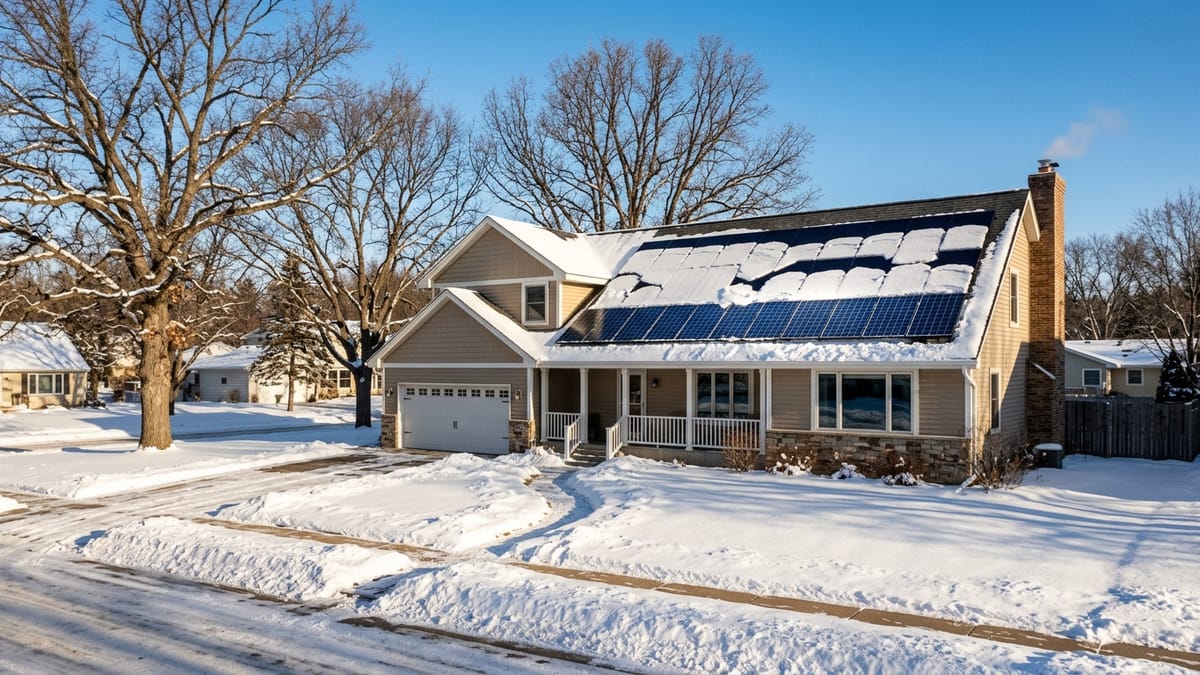
Leave it. On a pitched Illinois roof, snow usually slides off a solar array on its own once the sun comes back. It also costs less than it looks from the driveway. Sandia National Laboratories says published estimates of snow losses run 1% to 12% of a year's output, even though a single month can lose up to 100%. And in Illinois, December through February only make about 18% of the year's production anyway, on our town-level estimates.
Every winter I get the same call after the first real storm. The panels are white, the app says zero, and someone is standing at the bottom of a ladder with a push broom. Please don't. Even the U.S. Department of Energy says removing accumulated snow is not recommended.
Key facts: snow and solar in Illinois
| Fact | Figure | Source / window |
|---|---|---|
| Published annual snow-loss estimates | 1% to 12% of annual output | Sandia National Laboratories |
| Worst single-month snow loss | Up to 100% | Sandia National Laboratories |
| Normal seasonal snowfall, Chicago | 38.4 inches | NWS Chicago, 1991–2020 normals |
| Normal seasonal snowfall, Rockford | 37.1 inches | NWS Chicago, 1991–2020 normals |
| Normal seasonal snowfall, Peoria | 26.2 inches | NWS Lincoln, 1991–2020 normals |
| Normal seasonal snowfall, Springfield | 21.8 inches | NWS Lincoln, 1991–2020 normals |
| Normal seasonal snowfall, St. Louis (Metro East) | 16.6 inches | NWS St. Louis climate calendar |
| Days with 1 inch or more of snow on the ground | ~60 (northwest IL) to ~10 (southwest IL) | Illinois State Climatologist |
| Share of annual solar output made Dec–Feb | ~17.5% (Chicago) to ~18.4% (Belleville), est. | Our NREL-based town estimates, 7.5 kW array |
| Typical module load rating | 2,400 Pa (≈50 psf, my conversion) | U.S. DOE, FEMP winter-weather guidance |
Illinois is two snow states
The Illinois State Climatologist puts it simply: snowfall averages about 36 inches a year in the north and less than 10 inches in extreme southern Illinois, with the Chicago area boosted by lake-effect snow.
The weather service normals show the same split. Chicago's normal season is 38.4 inches and Rockford's is 37.1. Peoria normally gets 26.2 inches and Springfield 21.8. Across the river from Metro East, St. Louis averages 16.6.
What matters even more for solar is how long the snow sticks around. The climatologist's office counts about 60 days a year with an inch or more of snow on the ground in northwest Illinois, and only about 10 in the southwest.
A Rockford homeowner should expect a real stretch of buried mornings every winter. Down here around Belleville, plenty of snows are gone in a day or two. Neither one belongs on the roof.
What snow actually does to output
Snow blocks light, so a fully covered panel makes close to nothing. That part's real. What people miss is how fast it usually ends.
The Department of Energy's winter guidance for solar says most snow melts quickly off PV systems or blows off in the wind. Because panels sit at a tilt, snow slides down them, and the steeper the angle, the better they shed. DOE notes the sliding snow tends to bunch up unevenly along the bottom edge of the frame. As more of the dark glass clears and warms, the rest tends to let go.
That's why Sandia frames the loss the way it does. A bad month can lose everything. A whole year usually loses somewhere between 1% and 12%, depending on location and weather. With roughly six times as many snow-on-the-ground days in northwest Illinois as in the southwest, I'd expect Rockford-area roofs toward the upper part of that range and Metro East roofs near the bottom.
Why winter snow barely moves your year
Here's the part that surprises people. Even if snow wiped out every kilowatt-hour from December through February, it would only be touching a small slice of the year.
On our town-level estimates for a 7.5 kW array, December through February produce about 17.5% of the year's total in Chicago and about 18.4% in Belleville. Rockford, Peoria, Springfield, Champaign and Carbondale all landed between those two. Summer does the heavy lifting.
| Month | Chicago area (ComEd), est. | Belleville area (Ameren Illinois), est. |
|---|---|---|
| December | ~367 kWh | ~476 kWh |
| January | ~439 kWh | ~508 kWh |
| February | ~482 kWh | ~553 kWh |
| July, for comparison | ~800 kWh | ~852 kWh |
A fully buried week in a Chicago-area January costs about 100 kWh, a little under a quarter of that month's output.
To put a worst case on it: if a Chicago-area system lost the full 12% from the top of Sandia's range, that's roughly 880 kWh over a year. At ComEd's Price to Compare of 10.103¢ per kWh (Oct. 1, 2026 through May 31, 2027), that's about $89 of electricity for the whole year. Most years, and most homes south of I-80, should come in well under that. These are estimates; your roof, pitch and shading all move them.
I covered the full month-by-month seasonal curve separately. The short version is that a December array is still working; it just has less sun to work with.
Why I tell people not to clear it
The government agrees with me. The DOE's guidance says removing accumulated snow or ice is not recommended, and if you try, do it with extreme caution. It also says shovels can damage panels and that clearing them can do more harm than good.
The roof is the dangerous part, not the snow. A snowy, icy pitched roof is about the worst footing there is. Being wrong about it once costs far more than any electricity the snow is blocking.
Never stand on the panels. DOE is blunt about it: stepping or standing on panels will cause damage.
Skip the hot water. Whatever it does to the glass, it runs off and refreezes on the roof edge and in the gutter, which is a new problem you made yourself.
If you lease, it isn't your equipment. On a lease, the system belongs to the leasing company, and so does the job of maintaining it. Call them before you touch it. I wrote about who fixes what in more detail.
If you own the system and genuinely want the snow gone, the only approach I'd suggest is a soft tool made for solar glass, used from the ground. Honestly, even that is usually just impatience.
The two snow problems worth your attention
Sliding snow. Panels shed snow faster than shingles do, and it can come off in one heavy sheet. Look at what's under the array: a front door, a porch roof, a deck, the spot where you park, a gas meter. If the answer is people or anything breakable, ask about snow guards, and clean out the gutters before winter.
Weight on the roof. This one is rarer than people fear. DOE says a typical module is rated for 2,400 pascals, about 50 pounds per square foot by my conversion, and recommends modules certified for at least 5,000 pascals where heavy snow is a risk. If you're in the snowier north, that 5,000 figure is a fair question to ask about whatever panel you're quoted. The bigger question is the roof framing under the panels, which is why the roof gets checked before an install. If your roof is older or sagging, sort that out first. I wrote about whether you need a new roof before solar.
On insurance, Missouri's insurance regulator, in its winter-storm guidance, describes the typical homeowners policy as covering a collapse caused by the weight of ice, snow or sleet. Policies differ, so read yours. The questions to ask your agent about panels are in my Illinois homeowners insurance and solar breakdown.
Snow or broken? A quick check
- Snow: near-zero output starting the day of a storm, every panel at once, climbing back as the glass clears.
- Something else: zero output on a clear day with clear glass, or one group of panels lagging the rest.
- Give it time: two or three sunny days after a storm before you worry.
- Compare January to last January, not to July. Winter output in Illinois is normally about half of summer.
What it does to your bill
While the panels are covered, the house simply draws from Ameren or ComEd instead. Your banked summer credits are there to help cover this stretch. If you connected before 2025, check whether your credits reset in April or October; newer systems follow the 2026 net metering rules.
On a lease, how the snow lands depends on the contract. The Department of Energy describes solar leases as fixed monthly payments calculated from the system's estimated production, and a power purchase agreement as a set price per kilowatt-hour produced. On a set monthly payment, a snowy week doesn't change the bill. On a per-kWh agreement, a buried day makes almost nothing, so it bills almost nothing. The lease I offer is quoted as a predictable rate as low as $0.10/kWh. A loan payment, by comparison, is the same in a January blizzard as in July. Ask any company you're talking to whether the payment follows production or is a set monthly amount, and get the full rate schedule in writing.
The short version
Leave the snow alone. On a pitched Illinois roof it usually slides off within a few sunny days. Published estimates put snow at 1% to 12% of a year's output, and downstate Illinois sees far less lasting snow than the north. The winter months only carry about 18% of your year anyway. The real risks are a fall from the roof, damaged glass, and a sheet of snow landing on something below.
Want to see your own estimated winter numbers instead of a range? Run them in the calculator or check what your roof can hold. Questions about a system that's still showing zero after the snow is gone? Call me at (618) 217-2001 or reach out through the contact page.
Sources
- Sandia National Laboratories, "The Impact of Snow on PV Performance" (undated; "Published estimates of energy losses range from 1 to 12 percent annually, with monthly losses as high as 100 percent") — https://energy.sandia.gov/programs/renewable-energy/photovoltaic-solar-energy/projects/the-impact-of-snow-on-pv-performance/
- Sandia Lab News, "Photovoltaic panels catch the sun despite the snow" (July 14, 2022) — https://www.sandia.gov/labnews/2022/07/14/photovoltaic-panels-catch-the-sun-despite-the-snow/
- U.S. Department of Energy, Federal Energy Management Program, "Solar Photovoltaic Hardening for Resilience – Winter Weather" (snow shedding, removal guidance, 2,400 Pa / 5,000 Pa load ratings) — https://www.energy.gov/cmei/femp/solar-photovoltaic-hardening-resilience-winter-weather
- National Weather Service Chicago, 1991–2020 Monthly and Yearly Normals for Chicago and Rockford — https://www.weather.gov/lot/ord_rfd_monthly_yearly_normals
- National Weather Service Lincoln, Peoria 1991–2020 normals — https://www.weather.gov/ilx/pia-normal-monthly
- National Weather Service Lincoln, Springfield 1991–2020 normals — https://www.weather.gov/ilx/spi-normal-monthly
- National Weather Service St. Louis, April climate calendar (season-to-date normal snowfall 16.6 in.) — https://www.weather.gov/lsx/stl_apr
- Illinois State Climatologist, "Climate of Illinois" (snowfall north to south; days with 1 inch or more of snow depth) — https://stateclimatologist.isws.illinois.edu/climate-of-illinois/
- Missouri Department of Insurance, "Winter Storm Guidance" (Jan. 13, 2017; collapse "caused by the weight of ice, snow or sleet") — https://dci.mo.gov/node/1586
- U.S. Department of Energy, "Homeowner's Guide to Solar" (lease vs. power purchase agreement payment structures) — https://www.energy.gov/cmei/systems/homeowners-guide-solar
- Illinois Commerce Commission, Plug In Illinois: ComEd Price to Compare (10.103¢, Oct. 1, 2026 – May 31, 2027) — https://plugin.illinois.gov/understanding-the-price-to-compare/price-to-compare-comed.html
- National Laboratory of the Rockies (formerly NREL), Solar Resource Data API: monthly average tilt-at-latitude irradiance for Illinois towns (inputs to our town-level production estimates) — https://developer.nlr.gov/docs/solar/solar-resource-v1/