Generator or Home Battery for an Illinois Winter Outage? A 22 kW Generator Burns About $33 to $53 of Gas a Day
A whole-house standby generator burns about 57 therms of natural gas a day at half load, which works out to roughly $33 a day on Nicor Gas and $50 to $53 a day on Peoples Gas or Ameren Illinois gas at October 2026 prices. A 13.5 kWh home battery burns nothing, but it holds about a night's worth of the basics and needs the sun or the grid to refill. For most gas-heated Illinois homes the battery covers the outage you'll actually get. The generator earns its keep in multi-day ice storms, in homes with electric heat, and on rural feeders that stay down. Everything below is an estimate built from spec sheets and published rates, not a quote for your house.
I get this question every fall, usually from someone who just watched the neighbor's generator kick on while their own house went dark. Both machines solve the problem. They solve it at very different prices, and the right one depends on how you heat your house more than anything else.
The Short Version, in Numbers
| What | Figure | Source and date |
|---|---|---|
| Generac Guardian 22 kW, natural gas use | 228 cu. ft. per hour at half load, 327 at full load | Generac spec sheet, rev. March 2022 |
| Same unit, output | 19,500 W on natural gas, 22,000 W on propane | Generac spec sheet |
| Same unit, propane use | 2.53 gal. per hour at half load, 3.90 at full load | Generac spec sheet |
| Same unit, price | MSRP starting at $6,979 with whole-house switch, before installation | Generac product page, accessed Oct. 3, 2026 |
| Tesla Powerwall 3 | 13.5 kWh, up to 11.5 kW continuous, rated -4°F to 122°F | Tesla 2025 datasheet |
| Enphase IQ Battery 5P | 5.0 kWh usable, 3.84 kVA continuous | Enphase data sheet, May 2025 |
| Illinois outage minutes per customer, 2024 | 158 with major storms, 59 without (U.S.: 662.6 and 131.6) | EIA Electric Power Annual |
| Average length of an outage once it starts, 2024 | Ameren Illinois 191 minutes, ComEd 206 minutes | ICC annual report, Jan. 2026 |
| Utility battery rebate | $300 per kWh of storage, through Dec. 31, 2029 | 220 ILCS 5/16-107.6 |
The most important row is the outage one. The average Illinois customer was without power for about two and a half hours in all of 2024, counting major storms. The national figure was about 11 hours, pushed up by Hurricanes Beryl, Helene and Milton. Illinois outages are mostly an evening, not a week. The Illinois Commerce Commission's numbers say the same thing another way: once an outage starts, the average one lasted a little over three hours on both Ameren and ComEd in 2024.
Averages hide the bad years, though. Ameren's average outage ran 428 minutes in 2023, over seven hours, and anyone on a rural line in central Illinois remembers an ice storm that took days. Decide which of those two outages you're buying for before you buy anything.
What a Generator Costs to Run Here
Generac publishes fuel use at half and full load, nothing lighter. I use half load, about 9,750 watts on natural gas, as the planning number for a whole-house unit carrying a furnace, refrigerator, sump pump, lights and a few circuits. A lightly loaded generator should burn less than this, but the spec sheet doesn't say how much less, so read the table as a ceiling for a day of running.
| Gas utility (October 2026) | Delivery + supply per therm | Half load, per hour | Half load, per 24 hours | Full load, per 24 hours |
|---|---|---|---|---|
| Nicor Gas | 57.44¢ | about $1.36 | about $33 | about $47 |
| Peoples Gas (Chicago) | 87.67¢ | about $2.07 | about $50 | about $71 |
| Ameren Illinois gas | 93.58¢ | about $2.21 | about $53 | about $76 |
Those figures use Nicor's Rate 1 distribution charge of 24.44¢ plus its 33¢ October supply cost; Peoples' 46.583¢ distribution, 8.257¢ storage and 32.83¢ October gas charge; and Ameren's 48.344¢ distribution plus its 45.235¢ October gas charge. The Nicor and Peoples supply figures assume you buy gas from the utility rather than a supplier. Taxes, smaller per-therm riders and your monthly customer charge come on top, but you'd pay the customer charge anyway.
Three days at half load on Ameren gas runs about $159. That's real money, but it isn't what kills the generator math. The machine sits idle 360-plus days a year and still needs care. Generac's spec sheet lists a five-minute exercise run every other week (weekly or monthly are selectable), which by my math burns under $5 of gas a year even at the half-load rate. The bigger cost is service. Generac's own maintenance guide says units that operate in cold environments below 40°F need an oil and filter change every year or every 100 hours, which describes every Illinois winter.
On propane the same unit burns about 61 gallons a day at half load. Rural Ameren customers without a gas line should do that math against the tank they already have and what the propane dealer charges in January, because that's when the tank runs low.
What a Battery Actually Covers
A battery is a tank, not a fuel line. The Tesla Powerwall 3 holds 13.5 kWh and can push up to 11.5 kW at once. I sized the loads in detail in the battery sizing guide; here's the winter version.
With gas heat, one battery handles a normal Illinois outage. The furnace only needs power for the blower and controls. Fall River Electric, a rural co-op, lists furnace blowers at 700 to 800 running watts in its generator sizing guide, and newer variable-speed blowers often draw less. Add a refrigerator, lights, internet and the sump pump, and a 13.5 kWh battery wakes up the next morning with charge left. For the 59 to 158 minutes the average Illinois customer lost in 2024, it barely notices.
With electric heat, a battery buys you about an hour. The Silicon Valley Power appliance chart puts an electric furnace at 10.5 kWh per hour with the fan running. That empties 13.5 kWh in roughly an hour and twenty minutes. No home battery I'd sell carries resistance heat through a January night. If that's your house, keep reading the generator section, or check whether the ComEd electric space heat rate and a heat pump change your plans first.
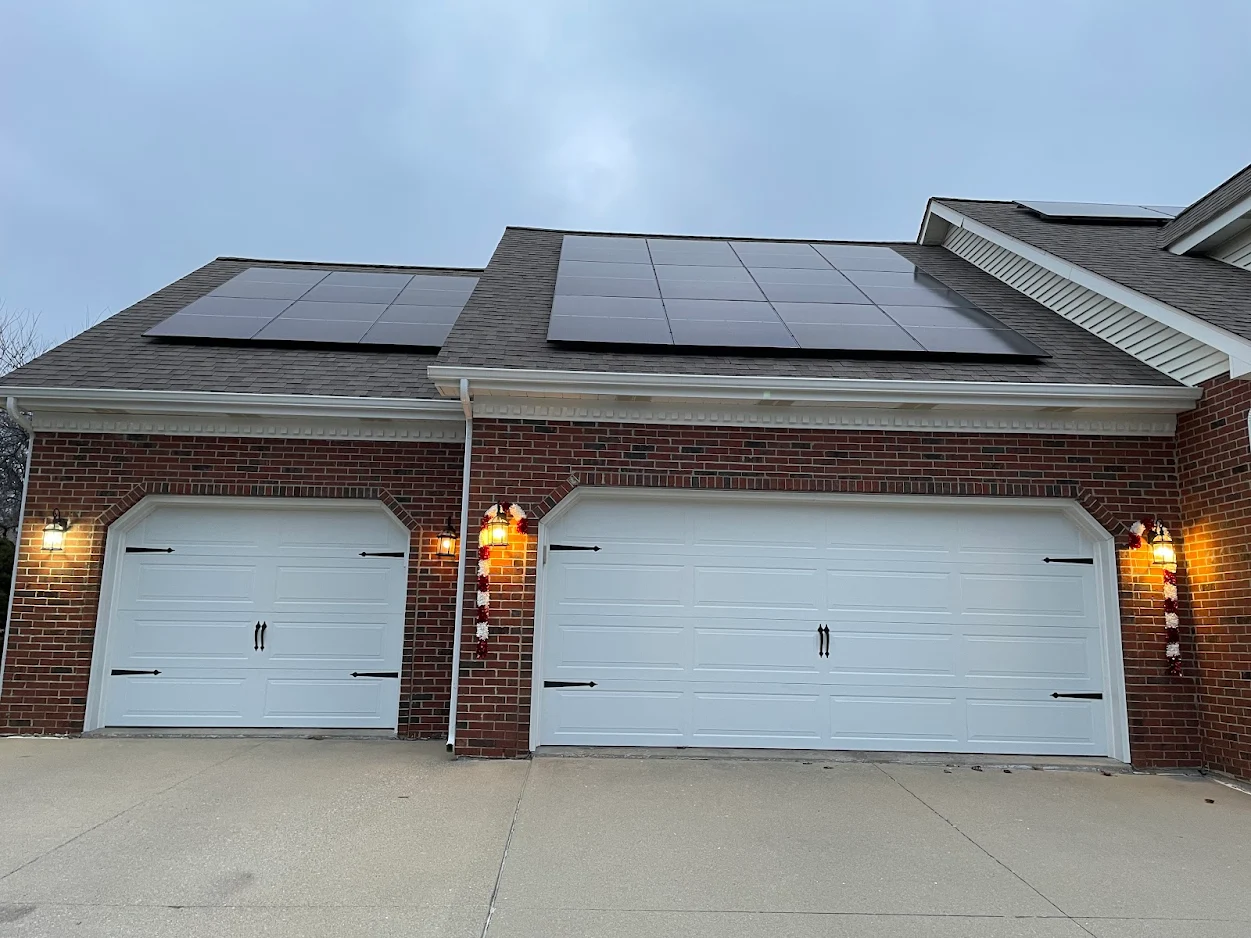
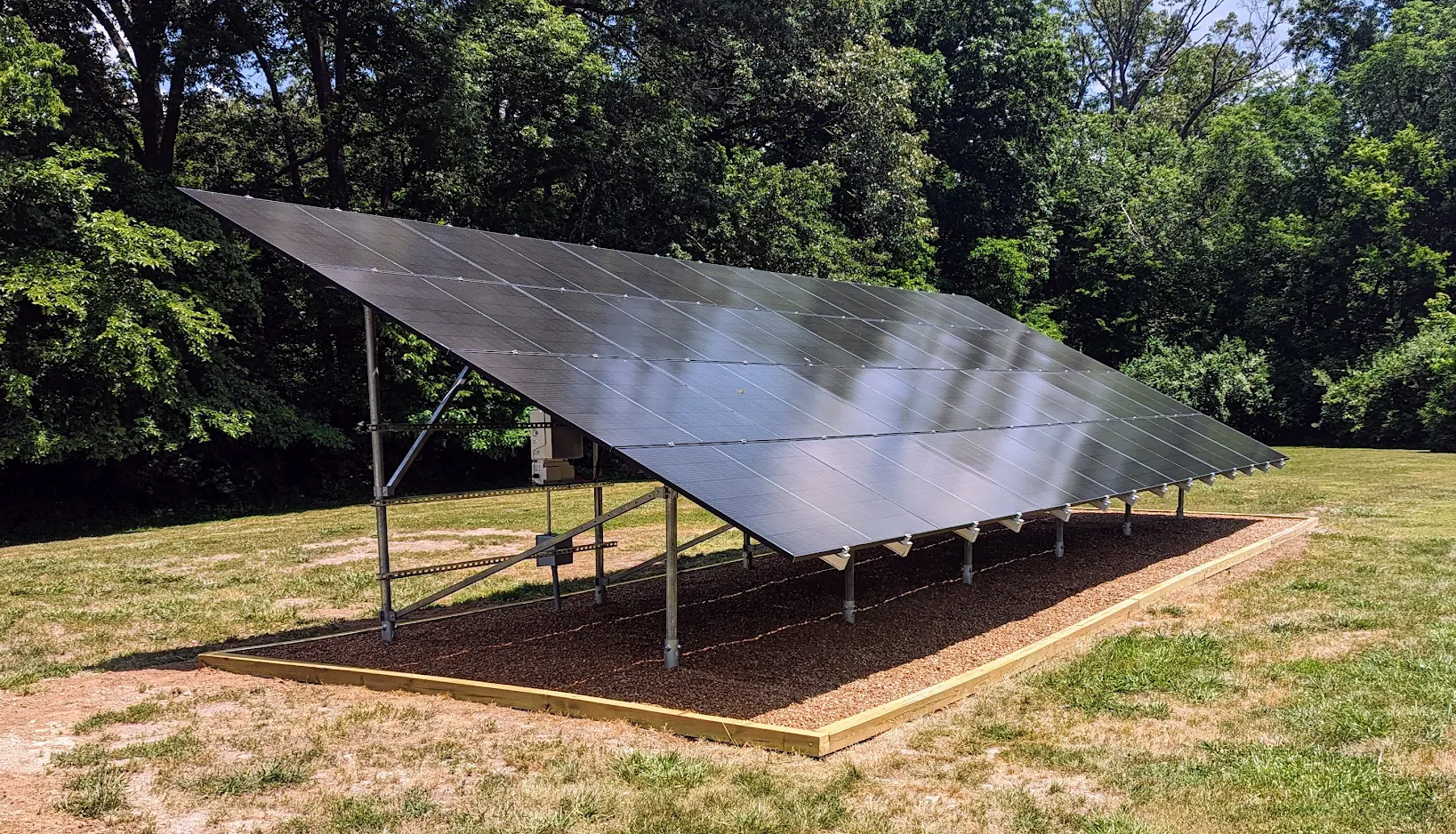
Solar is what turns a battery into multi-day backup. On their own, grid-tied panels go dark in an outage; the Department of Energy notes they're "designed to switch off if the grid power cuts out." With a battery they keep running. A 7.5 kW system averages an estimated 14.3 kWh a day from December through February in Chicago and about 17.1 kWh in Belleville, enough on an average winter day to refill one battery. The catch is the word average. A gray week or panels buried in snow can produce close to nothing, and an ice storm doesn't wait for a sunny week.
Cold matters too, but less than people think. Tesla rates the Powerwall 3 to operate down to -4°F. Enphase lists 32°F to 86°F as the IQ 5P's optimum range, so a garage or basement install is smarter than a north wall in Rockford.
The Upfront Side
Generac lists the 22 kW Guardian at an MSRP starting at $6,979 for the unit. That model is sold with a whole-house transfer switch, but the electrician, the concrete pad, the gas line, and the permit don't, so get a local installed quote before you compare.
Battery pricing is harder to pin down from a primary source. Lawrence Berkeley National Laboratory's August 2026 data update found that median cash prices for residential solar-plus-storage ran $2.1 per watt higher than solar alone in 2025, with a median battery of 13.5 kWh and a median system of 7.7 kW. Multiplying those two medians gives roughly $16,000 for the battery, which is my math, not the lab's, and the lab notes about 80% of that pricing data comes from California. ComEd and Ameren Illinois both pay $300 per kWh of storage, about $4,050 on a 13.5 kWh battery, which brings that rough figure near $12,000 before anything else. The rebate has strings: both utilities now require the battery to enroll in a virtual power plant program, ComEd also requires a time-varying supply rate for the life of the battery, and Ameren's solar page still says a rebated battery must be charged by on-site renewables like your panels. I covered both in the battery rebate breakdown.
The difference that matters to me is what each one does on the other 360 days. A generator only pays you back during a blackout. A battery tied to solar works every day, storing your own production and feeding the house in the evening. On the 25-year solar leases I sell, a battery is included, so backup comes with the panels instead of as a separate check.
Safety Isn't a Footnote
The Consumer Product Safety Commission's May 2026 report calls generators "the single product under CPSC's jurisdiction that is associated with the most CO deaths," an estimated annual average of 98 deaths from 2020 to 2022. Over the same years, 59% of all non-fire carbon monoxide deaths tied to consumer products happened in November through February, Illinois outage season. The CDC says to use one only outside, "more than 20 feet away from any windows, doors, and vents," never in a garage, even with the door open.
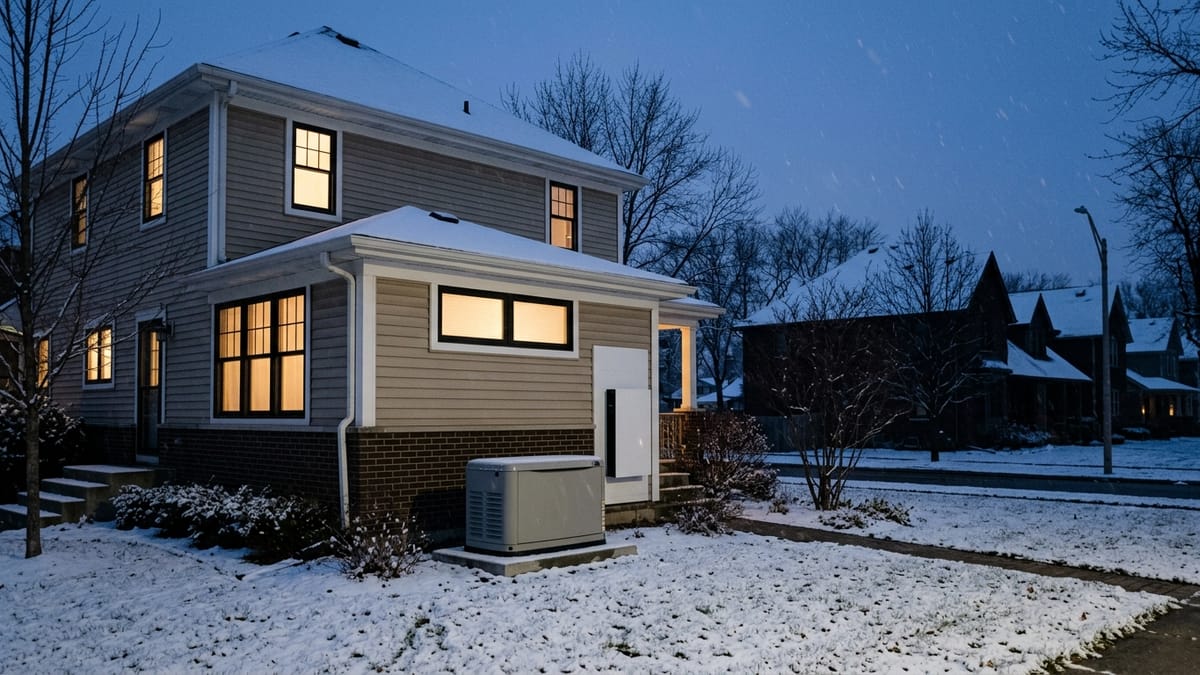
A permanently installed standby unit is a different machine. Generac's spec sheet allows the Guardian to sit as close as 18 inches from the house, subject to local code. Illinois law, 430 ILCS 135/10, already requires a carbon monoxide alarm within 15 feet of every bedroom. Make sure yours has a battery backup, because a hard-wired alarm without one goes quiet in the same outage that started the generator.
A battery has none of that risk. No exhaust, no fuel on site, and nothing to start.
My Take
If you heat with gas and live in town, buy for the outage Illinois actually has: a few hours, a few times a year. One battery, ideally paired with solar, covers that quietly, and it earns its keep on the days the grid is fine. If you heat with electricity, run a well pump on a rural Ameren line, or you're still thinking about the last ice storm, a natural gas standby generator is the better backup. At about $33 to $53 a day in fuel, it's a reasonable price for heat in a three-day outage.
Plenty of rural homes end up with both, a battery for the everyday flickers and a generator for the rare long one. That's not overkill if the long ones are what you've lived through. For the bigger picture on whether Illinois is headed for more outages, I wrote up the rolling blackout question separately, and the short answer is less dramatic than the headlines.
Get Your Own Numbers
Run your bill through the savings calculator to see what solar with a battery looks like on a lease or a purchase, or call me at (618) 217-2001. Tell me how you heat and how long your last outage lasted, and I'll tell you honestly whether a battery covers you or whether you need a generator. You can also send a bill through the contact page.
Sources
- Generac Guardian 20/22/24 kW air-cooled spec sheet — Generac, Part No. A0000937814 Rev. E, March 15, 2022 (22 kW: NG 228 / 327 cu. ft. per hour at half / full load; LP 2.53 / 3.90 gal. per hour; 19,500 W NG, 22,000 W LP; 5-minute exercise every other week; installs as close as 18 in. from a structure)
- Generac 22 kW Standby Generator, model 7043 — Generac product page, accessed Oct. 3, 2026 (MSRP starting at $6,979)
- Generac home standby maintenance schedule — Generac Support, Nov. 18, 2025 (below 40°F: oil and filter change every year or 100 hours)
- EIA, How to convert natural gas prices to therms — U.S. Energy Information Administration (2025 average about 1,037 Btu per cubic foot) and British thermal units (1 therm = 100,000 Btu)
- Hurricanes in 2024 led to the most hours without power in the United States in 10 years — EIA Today in Energy, Dec. 1, 2025 (U.S. average 11 hours in 2024; Beryl, Helene and Milton 80% of the hours)
- Nicor Gas Rate 1 Residential Service — Nicor Gas, 22nd Revised Sheet No. 10, effective Sept. 28, 2026 (distribution 24.44¢ per therm, all therms)
- ICC Purchased Gas Adjustment Rates — Illinois Commerce Commission, accessed Oct. 3, 2026 (October 2026: Nicor $0.3300, Peoples Gas $0.3283 per therm)
- Peoples Gas rates — Peoples Gas, Rate 1 heating (distribution 46.583¢, storage 8.257¢ per therm)
- Ameren Illinois Rate GDS-1 — effective Jan. 16, 2026 (distribution 48.344¢ per therm) and Purchased Gas Adjustment, October 2026 (45.235¢)
- Powerwall 3 Datasheet, North America — Tesla, 2025 (13.5 kWh, 11.5 kW continuous, -4°F to 122°F)
- IQ Battery 5P Data Sheet — Enphase Energy, May 2025 (5.0 kWh usable, 3.84 kVA continuous, optimum 32°F to 86°F)
- EIA Electric Power Annual, Table 11.4, reliability by state — 2024 SAIDI (Illinois 158.0 minutes with major event days, 59.1 without; U.S. 662.6 and 131.6)
- ICC 2025 Annual Report on Electricity, Gas, Water and Sewer Utilities — Illinois Commerce Commission, Jan. 21, 2026 (CAIDI 2024: Ameren Illinois 191, ComEd 206 minutes; Ameren 2023: 428)
- Standby Generator Guide — Fall River Rural Electric Cooperative (furnace fan blower 700 to 800 running watts)
- Appliance Energy Use Chart — Silicon Valley Power, City of Santa Clara (electric furnace 10.5 kWh per hour with fan)
- Solar and Resilience Basics — U.S. Department of Energy (grid-tied systems "designed to switch off if the grid power cuts out")
- U.S. Distributed Solar and Storage, 2026 Data Update — Lawrence Berkeley National Laboratory, August 2026 (paired PV+storage $2.1/W higher; median storage 13.5 kWh; median system 7.7 kW; ~80% of paired pricing data from California)
- 220 ILCS 5/16-107.6 — Illinois Compiled Statutes, distributed generation rebates ($300 per kWh of storage through Dec. 31, 2029)
- ComEd Distributed Generation Rebate Terms and Conditions, 2026 — ComEd, 2026 (Qualifying Utility Product for the life of the storage; Scheduled Dispatch Virtual Power Plant participation)
- Ameren Illinois DER Bulletin 2026-04 — Ameren Illinois, 2026 (ESS rebate requires SD VPP enrollment) and Ameren solar page (ESS "must be charged by an on-site generator that uses a renewable resource")
- Non-Fire Carbon Monoxide Deaths Associated with the Use of Consumer Products, 2022 Annual Estimates — U.S. Consumer Product Safety Commission, May 2026 (generators: annual average 98 deaths, 2020–2022; 59% of all non-fire CO deaths November–February)
- Carbon Monoxide Poisoning Basics — CDC, reviewed Jan. 12, 2026 (generators outside, more than 20 feet from windows, doors and vents)
- 430 ILCS 135/10, Carbon Monoxide Alarm Detector Act — Illinois Compiled Statutes (alarm within 15 feet of every room used for sleeping)