What It Costs to Charge an EV at Home in Illinois This Winter: About $49 a Month on ComEd, $32 to $45 on Ameren
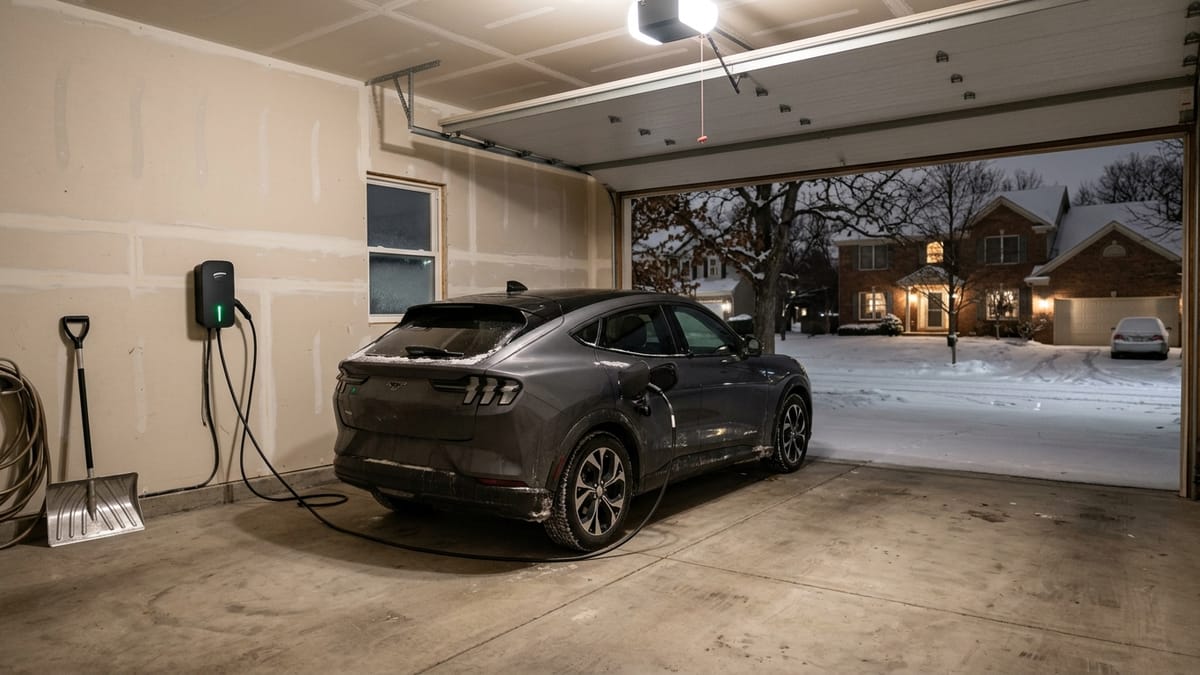
Charging an electric car at home in Illinois this winter costs an estimated $49 a month on ComEd and $32 to $45 a month on Ameren Illinois for 1,000 miles of driving, before taxes and small riders. That's with ComEd's filed October 2026 supply charges and Ameren's October rate sheet. The same 1,000 miles in a 28-mpg gas SUV costs about $157 at the Midwest's $4.39 average gas price for the week of September 21. Charge overnight on one of the utilities' EV-friendly programs and the electric side drops further; on ComEd's overnight time-of-day window, the supply and delivery lines cost less than half what they do on the standard rate.
Most of the "cost to charge an EV in Illinois" pages out there use one statewide average rate. That's close enough for a brochure, but it misses the two things that actually move an Illinois charging bill: which utility you're on, and what time of night the car pulls power. Here's the math for both.
Key facts: charging an EV at home in Illinois, 2026
| Line | Figure | In effect |
|---|---|---|
| ComEd supply + transmission, standard rate | 10.103¢/kWh (8.413¢ + 1.69¢); ComEd's filed sheets showed about 9.964¢ | Oct 1, 2026 – May 31, 2027 (ICC Plug In Illinois) |
| ComEd supply, summer (Price to Compare) | 10.399¢/kWh | June 1–Sept 30, 2026 |
| ComEd delivery, single-family, no electric heat | 6.333¢/kWh + 0.128¢ distribution tax | Bills from April 2026 |
| ComEd Time-of-Day, Overnight (9 p.m.–6 a.m.) | Supply 3.394¢ + delivery 3.345¢ per kWh | Supply: Oct 2026–May 2027 periods; delivery: bills from April 2026 |
| Ameren supply, summer (Price to Compare) | 11.326¢/kWh | June 1–Sept 30, 2026 |
| Ameren supply, Oct 2026 (Price to Compare) | 10.441¢ first 800 kWh, 8.262¢ above | Oct 1, 2026 – May 31, 2027 (ICC Plug In Illinois) |
| Ameren delivery | 7.811¢ summer; 4.572¢ first 800 kWh and 2.427¢ above, non-summer | 2026 billing periods |
| Ameren ChargeSmart credit, 11 p.m.–7 a.m. | 2¢/kWh summer, 1¢/kWh Oct–May, plus $4/month for 12 months | Current program terms |
| Typical 2026 EV efficiency (EPA, wall-to-wheels) | Tesla Model Y 24–27 (most trims), Ioniq 5 29–36, Mach-E 31–34, F-150 Lightning 47–51 kWh/100 mi | 2026 model years (Lightning: 2025) |
| Midwest regular gasoline | $4.386/gallon | Week of Sept 21, 2026 (EIA) |
The monthly math, utility by utility
I used 1,000 miles a month and 30 kWh per 100 miles, which is 300 kWh at the plug. EPA measures its kWh-per-100-miles figure from the wall outlet, so charging losses are already in there. If you drive a Model 3 or Model Y, you'll land a bit under these numbers. A pickup lands well over them.
Updated September 30, 2026: the Illinois Commerce Commission has now posted the October 1, 2026 – May 31, 2027 Prices to Compare. ComEd's is 10.103¢/kWh (8.413¢ supply plus 1.69¢ transmission), 0.139¢ above the 9.964¢ from ComEd's filed sheets used for the ComEd estimates in this post, so those run about 0.14¢ per kWh low. Ameren Illinois' is 10.441¢ on the first 800 kWh and 8.262¢ above 800, matching the Ameren estimates here.
| Utility and price tier | Supply + delivery per kWh | 300 kWh (typical EV) | 480 kWh (electric pickup) |
|---|---|---|---|
| ComEd standard, Oct–May (est.) | 16.4¢ | $49 | $79 |
| ComEd standard, summer 2026 | 16.9¢ | $51 | $81 |
| Ameren, Oct–May, inside first 800 kWh (est.) | 15.0¢ | $45 | $72 |
| Ameren, Oct–May, above 800 kWh (est.) | 10.7¢ | $32 | $51 |
| Ameren, summer 2026 | 19.1¢ | $57 | $92 |
| Gas: 28-mpg SUV / 20-mpg pickup at $4.386 | — | $157 | $219 |
None of those rows include taxes or the small state program riders, which ran about 1.8¢ per kWh on Ameren's own sample bill. Add that and the electric rows still come in at roughly a quarter to a little under half of the gas rows.
Over a year of 12,000 miles, that's an estimated $600 on ComEd and $490 to $590 on Ameren, against about $1,880 in gas for the 28-mpg SUV. Call it $1,300 a year back in your pocket on fuel alone, before insurance and maintenance differences, which I'm not going to pretend I can estimate for your car.
Why Ameren's winter is the cheapest standard-rate charging on either utility
This part surprises people. From October through May, Ameren splits every month at 800 kWh, and everything above that line is cheaper on both the supply side and the delivery side. Delivery drops from 4.572¢ to 2.427¢. Ameren's October 2026 rate sheet puts the energy charge at 7.310¢ on the first 800 kWh and 5.131¢ above, which works out to an estimated 10.44¢ and 8.26¢ once transmission and adjustments are added. The ICC hasn't posted the official October Price to Compare yet, and Ameren's annual sheet had slightly different figures, so the first-tier number could land closer to 10.2¢.
What that means for a car: the EV is the last thing to add kilowatt-hours in a month. If your house in Springfield or Belleville already uses 800 kWh in a January billing period, which plenty of homes with electric water heaters or baseboard heat do, every kWh the car pulls is billed at about 10.7¢. A smaller house that stays under 800 pays about 15.0¢ for the first part of the car's usage and 10.7¢ once the car pushes it over.
Summer is the other side of that coin. Ameren's June-through-September supply price of 11.326¢ on top of 7.811¢ delivery is the most expensive charging in this table. Every line on an Ameren bill is broken out in the Ameren bill explained, and current figures live on the Ameren rates page.
Charge overnight and ComEd gets cheap fast
ComEd's standard rate is a one-price-all-day setup, and at about 16.4¢ it's the middle of the pack. The two programs built for EV owners are where ComEd pulls ahead.
Time-of-Day pricing. ComEd's Overnight window runs 9 p.m. to 6 a.m., and for October 2026 through May 2027 the supply price in that window is 3.394¢ per kWh. The overnight delivery charge for a single-family home without electric heat is 3.345¢. Those two lines total about 6.7¢, before transmission, taxes, and riders, which is less than half the roughly 14.7¢ the same two lines cost on the standard rate (8.241¢ supply plus 6.46¢ delivery). On 300 kWh, those lines come to about $20 a month. ComEd adds a $2 monthly credit per EV for up to 24 months, on up to two vehicles. The catch is the 1 p.m. to 7 p.m. Mid-Day Peak, which is priced far higher, and in summer that's when central air runs hardest. I laid out who wins and who loses in ComEd time-of-day pricing: worth it?
Hourly Pricing. ComEd says EV owners on Hourly Pricing who charge between 1 a.m. and 5 a.m. could save 25% on supply compared with its fixed-price rate, measured as an average from January 2007 to May 2026. That's ComEd's own long-run figure, not a promise for this winter. Hourly prices can spike, and a cold snap is when they do. ComEd's EV page also notes that its charger rebates have required staying on a flexible rate like Hourly Pricing for at least three years, and that switching rates can take one to three months to take effect.
My take: if you're on ComEd and drive an EV, the standard rate is the most expensive way to charge. Pull up ComEd's rate comparison tool in My Account and run your own usage through it before switching anything.
Ameren's ChargeSmart: small credits, one catch
Ameren's EV program is called ChargeSmart. It pays a credit of 2¢ per kWh in summer and 1¢ per kWh from October through May for power used in its Preferred Charging Period, 11 p.m. to 7 a.m., plus a $4 bill credit each month for the first 12 months. On 300 kWh of overnight charging, that's about $3 a month in winter and $6 in summer, plus the $4.
The catch is a charge of $0.65 per kWh on your household's highest single hour of use between 11 a.m. and 7 p.m. in each billing period. In Ameren's words, it applies "during the highest one hour of total household usage from the billing period that occurs within this timeframe." A house that pulls 4 kWh in its worst summer-afternoon hour would owe about $2.60 for that month. Plug the car in at 5 p.m. by mistake and that hour could cost much more. Set the charger's schedule and leave it alone. Ameren's energy-efficiency program also offers a $50 rebate on a home charger from its eligible list, one per household.
Where solar fits for an EV household
An EV adds about 3,600 kWh a year to a house driving 12,000 miles. Our town-level production data, built from NREL solar resource figures, puts a kilowatt of Illinois panels at about 979 kWh a year in Chicago, 998 in Naperville, 1,117 in Belleville, and 1,244 in Springfield. That's roughly 2.9 to 3.7 kW of extra panels to cover the car, depending on where you live.
I'll be straight about the timing problem. Panels produce at midday, and most people charge at night. Systems connected since January 1, 2025 get supply-only net metering, so a daytime surplus earns supply credit, not delivery credit, and those credits have their own expiration rules, covered in when Illinois net metering credits expire. A home battery, a weekend-afternoon charging habit, or pairing solar with a time-of-day rate closes much of that gap. Sizing a battery around a car is its own question, and how big a battery you need to run a house walks through it.
With a $0-down lease, the power your panels produce is billed at a predictable rate as low as $0.10 per kWh, the full 25-year rate schedule is set in your contract before you sign, and a battery is included. Compare that with the 16.4¢ to 19.1¢ the utilities charge on their standard rates for the same kilowatt-hour. The month-by-month version of that math is in solar lease cost per month in Illinois, and for the rest of your bill, the average Illinois electric bill breakdown shows where a typical ComEd or Ameren home lands this year.
If you've got an EV or one on order, send me a recent ComEd or Ameren bill. I'll tell you which rate your charging costs the least on, what the car adds to your bill, and whether sizing solar for it pencils out. Every number is an estimate until it's your bill. Call (618) 217-2001, run your address through the savings calculator, or get in touch here.
Sources
- ComEd, Electric Informational Sheets (ICC current tariff book): 85th Revised Informational Sheet No. 1, Purchased Electricity Charges, and 76th Revised Informational Sheet No. 2, PJM Services Charges, effective August 21, 2026 (non-summer 8.241¢ and 1.723¢ through May 2027) — https://icc.illinois.gov/downloads/public/tariff/currentbooks/1/Electric%20Informational%20Sheets%20Ill.%20C.%20C.%20No.%2010[186]..pdf
- ComEd, A Guide to the Retail Customer's Billed Delivery Service Charges, resultant charges beginning with April 2026 bills (single-family without electric space heat 6.333¢ + IEDT 0.128¢; Time-of-Day delivery, Overnight 3.345¢) — https://www.comed.com/cdn/assets/v3/assets/blt3ebb3fed6084be2a/blt7904befea93c3525/6a74ab1af8608b565710881f/A_Guide_to_the_Retail_Customer_s_Billed_Delivery_Service_Charges.pdf
- ComEd, 2nd Revised Informational Sheet No. 70, Basic Electric Service Time of Use Electricity Charges, effective August 21, 2026 (ICC current tariff book; non-summer Overnight 3.394¢, September 2026–May 2027 billing periods) — https://icc.illinois.gov/downloads/public/tariff/currentbooks/1/Electric%20Informational%20Sheets%20Ill.%20C.%20C.%20No.%2010[186]..pdf
- ComEd, Informational Sheet No. 68, Electric Vehicle Customer Incentive for Enrollment in Distribution Time of Use Pricing ($2.00 monthly credit, from January 2026 billing) — same ICC tariff book
- ComEd, Time-of-Day Pricing program page (Overnight 9 p.m.–6 a.m.; Mid-Day Peak 1–7 p.m.; $2 monthly EV credit per vehicle, up to 24 months, up to two vehicles) — https://www.comed.com/ways-to-save/for-your-home/manage-my-energy/time-of-day-pricing
- ComEd Hourly Pricing, Electric Vehicles (25% average supply savings for EV participants, January 2007 – May 2026; charge 1 a.m.–5 a.m.; three-year flexible-rate requirement for rebates; enrollment takes 1–3 months) — https://hourlypricing.comed.com/electric-vehicles/
- Illinois Commerce Commission, Plug In Illinois: ComEd Price to Compare (10.399¢, June 1 – Sept 30, 2026; October not posted as of Sept 25, 2026) — https://plugin.illinois.gov/understanding-the-price-to-compare/price-to-compare-comed.html
- Illinois Commerce Commission, Plug In Illinois: Ameren Illinois Price to Compare (11.326¢, June 1 – Sept 30, 2026; October not posted as of Sept 25, 2026) — https://plugin.illinois.gov/understanding-the-price-to-compare/price-to-compare-ameren-illinois.html
- Ameren Illinois, Rider HSS / Rider BGS 124th Informational Sheet, effective October 2026 (non-summer energy charge 7.310¢ / 5.131¢) — https://www.ameren.com/-/media/rates/illinois/residential/electric-rates/historical-retail-2016-to-present/2026/aiifhss1026.ashx
- Ameren Illinois, Rate PBR-R Appendix, effective August 28, 2025 (DS-1 distribution delivery 2026: 7.811¢ summer, 4.572¢ / 2.427¢ non-summer) — https://www.ameren.com/-/media/rates/illinois/residential/electric-rates/distribution-delivery/aiel8rtpbrr08282025.ashx
- Ameren Illinois, ChargeSmart (Preferred Charging Period 11 p.m.–7 a.m.; 2¢/1¢ per kWh credits; $0.65/kWh highest-hour charge 11 a.m.–7 p.m.; $4 monthly credit for 12 months), accessed Sept 25, 2026 — https://www.ameren.com/illinois/residential/electric-vehicles/chargesmart
- Ameren Illinois Energy Efficiency Program, Electric Vehicle Home Charger (rebate up to $50), accessed Sept 25, 2026 — https://amerenillinoissavings.com/residential/ev-home-charger/
- Ameren Illinois, sample residential bill, statement dated March 27, 2025 (taxes and other charges, about 1.8¢/kWh) — https://www.ameren.com/-/media/files/account/understanding-your-bill/basic-service-sample-il.ashx
- U.S. DOE / EPA, fueleconomy.gov, 2025–2026 electric vehicle ratings (kWh/100 mi) — https://www.fueleconomy.gov/feg/PowerSearch.do?action=noform&path=1&year1=2026&year2=2026&vtype=Electric&srchtyp=newAfv
- U.S. EPA, Fuel Economy and EV Range Testing (EV ratings include charging losses, measured at the wall outlet) — https://www.epa.gov/greenvehicles/fuel-economy-and-ev-range-testing
- U.S. Energy Information Administration, Gasoline and Diesel Fuel Update (Midwest regular $4.386, week of Sept 21, 2026) — https://www.eia.gov/petroleum/gasdiesel/
- NREL, National Solar Radiation Database (source for our town-level annual production per kW) — https://nsrdb.nrel.gov/