Solar Farm Lease Rates in Illinois (2026): Farm Managers Report $1,000 to $2,999 an Acre
Most Illinois farmland offered a new utility-scale solar or wind lease this year was offered $1,000 to $1,999 an acre per year. That's from the Illinois Society of Professional Farm Managers and Rural Appraisers' Mid-Year Snapshot Survey, published August 27, 2026: 63% of respondents reported that band, 31% reported $2,000 to $2,999, 6% reported more than $3,000, and no one reported an offer under $1,000. The same survey put 2026 cash rent at $227 to $384 an acre, depending on land quality.
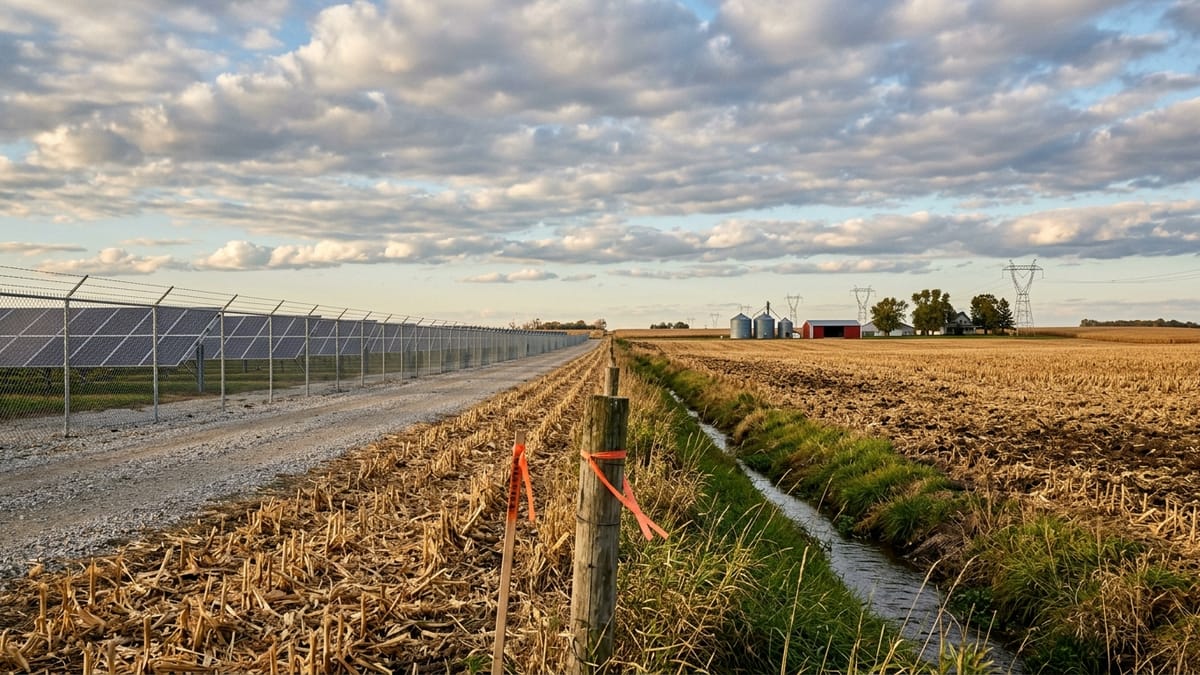
That gap is why the letters keep showing up in mailboxes around Springfield, Decatur, Taylorville and Effingham. I don't broker land leases. I put solar on homes, shops and farm buildings across Central and Southern Illinois. But these offers come up at kitchen tables, and the questions are always the same: is the number fair, who pays the taxes, and what's left of the field when the panels come out. Here's what the state's own documents say.
Key facts: Illinois solar land leases, 2026
| Item | Figure | Source / date |
|---|---|---|
| Most common offer, new utility-scale solar or wind lease | $1,000–$1,999 per acre per year (63% of respondents) | ISPFMRA Mid-Year Snapshot, Aug 27, 2026 |
| Higher offers | $2,000–$2,999 (31%); more than $3,000 (6%) | Same survey |
| Offers under $1,000 an acre | None reported | Same survey |
| Battery storage base rent (7 respondents) | 4 at $1,500–$4,999; 2 at $5,000–$9,999; 1 at $10,000+ per acre | Same survey |
| 2026 average cash rent | $384 excellent, $325 good, $277 average, $227 fair (per acre) | Same survey |
| Who pays property tax on the solar parcel | The solar company (separate parcel number) | 35 ILCS 200/10-740 and 10-745 |
| Removal deadline after the project's useful life ends | 12 months, at the company's expense | Standard Solar AIMA (IDOA), Section 17.B |
| Removal money posted with the county | 10% by year 1, 50% by year 6, 100% by year 11 | Standard Solar AIMA, Section 17.D |
What farm managers actually saw this year
The survey drew 50 responses from farm managers, land brokers and rural appraisers, and it covers the first half of 2026. Of the respondents managing farmland, 48% had a farm sign a new wind or solar agreement in that window. That's a lot of activity for six months.
Two cautions before you hold an offer up against those numbers. First, the survey groups solar and wind together, so it isn't a pure solar figure. Second, these are offered annual rates reported by professionals, not an average of every signed contract in the state. Even so, it's the best Illinois-specific data I've seen. Juo-Han Tsay of the University of Illinois, who co-presented the results, was quoted in AgriNews saying there's no comparable Illinois data on these topics right now.
What moves your number within that range is mostly out of your hands: how close the ground is to a substation or transmission line with capacity left, how square and flat the parcel is, and how many developers are working your county at once.
How a land lease compares to cash rent
The rent gap is the whole story for a lot of families, so here it is in one table, using the survey's own 2026 cash rent averages.
| Land quality | 2026 average cash rent | A $1,000/acre offer is about | A $2,000/acre offer is about |
|---|---|---|---|
| Excellent | $384 | 2.6× cash rent | 5.2× cash rent |
| Good | $325 | 3.1× | 6.2× |
| Average | $277 | 3.6× | 7.2× |
| Fair | $227 | 4.4× | 8.8× |
On 40 acres of good ground, the bottom of the common band works out to about $40,000 a year, against roughly $13,000 of cash rent. Managers also expect 2027 cash rents to slip by an average of $3 to $5 an acre, so the gap isn't closing.
The money isn't the hard part of the decision, though. The ground leaves crop production for the life of the project, and every dollar depends on one company holding up its end. That's why the contract terms below matter as much as the rate.
Why some websites still show about $400 an acre
If you've searched this already, you've probably seen national lease-rate sites quoting an Illinois average in the $400s per acre. One I checked this week lists $438 an acre, in a range of $307 to $613.
Those figures sit below every offer the Illinois survey recorded. My guess is they come from generic national formulas rather than Illinois deal flow. Either way, if an offer letter quotes you a number in that range, it's worth asking around before you treat it as normal.
Who pays the property taxes
The solar company does, by statute. Section 10-745 of the Property Tax Code says the owner of a ground-installed commercial solar energy system "shall be liable for the real estate taxes for the land and real property improvements" of that system. If you're curious how this differs from rooftop solar on a house, I covered that in whether solar panels raise your property taxes in Illinois.
Section 10-740 sets up the mechanics. The company pays an Illinois-registered land surveyor to map the land it has exclusive control over, including access routes, and delivers the survey to you and the county assessor. Once you sign off, the assessor issues a separate parcel number for that area, used only for property tax.
One protective detail: the law lets the landowner pay any unpaid tax on the solar parcel "prior to the initiation of any tax sale proceedings." You'd rather never use that, but it means a delinquent developer can't quietly put your ground at risk.
The farmland protections Illinois already wrote down
Projects of 500 kilowatts or more on farmland come under the Renewable Energy Facilities Agricultural Impact Mitigation Act. The company signs an Agricultural Impact Mitigation Agreement, or AIMA, with the Illinois Department of Agriculture, and the county makes it a condition of the permit. The standard solar form, version 8.19.19 on the Department's site, covers more than most landowners expect:
- Drain tile. Tile damaged by the project must be repaired or replaced with tile of comparable quality, and the company files "as built" maps of tile and cable locations.
- Topsoil. Topsoil has to be stored separately from subsoil and put back to its original depth and contour as closely as practical.
- Cable depth. Cables can sit as shallow as 18 inches inside the fence only if they come out at the end. Cables buried 5 feet or deeper may stay.
- Removal. The company must finish removal within 12 months after the project's useful life ends, at its own expense.
- Missed payments. If the company doesn't pay you for 6 consecutive months, the project is presumed to have reached the end of its useful life. That starts the removal clock.
- Removal money. The company posts financial assurance with the county: 10% of estimated removal cost by the first anniversary of operation, 50% by the sixth and 100% by the eleventh.
Here's the part I'd underline. The AIMA calls itself the minimum standard. Most of it can be changed by negotiation with the landowner, but only before the work happens, and the removal timing and financial assurance sections can't be negotiated away at all. So the AIMA is your floor, and your lease is where you build on top of it. And the company has to give you a copy of the AIMA at least 30 days before construction starts.
What I'd check before signing
None of this replaces an attorney who does farm and energy contracts, and I'd hire one. Here's the list I'd bring to that meeting:
- When rent starts. Many deals begin with an option period at a lower payment. Ask for that payment in writing, and ask how long the company can hold the option before it builds or walks away.
- Total term and extensions. Know the longest the company can keep the ground, counting every extension it can choose on its own.
- Rent increases. If the rent rises over time, get the schedule in writing. A flat number loses ground to inflation over a long term.
- Crop damage and access. Who pays for crop loss during construction, and where can trucks go?
- Tile and drainage on the rest of the farm. The AIMA covers lines the project damages, including adjacent lines it disrupts. Ask the lease to spell out how fast repairs happen during planting and harvest.
- Removal and the bond. Confirm the lease points to the AIMA removal terms and says who can call on the money.
- Taxes on your remaining acres. The company pays the solar parcel. Ask what happens if your other land's assessment changes.
- Your lender. In the survey, 73% of managers were unsure whether ag lenders are changing their approach to farmland under long renewable leases. Call yours before you sign.
- Sale and assignment. The company that signs may not be the one that builds or operates. Know what changes if the contract is sold.
On the upside, an active lease seems to help land value. In the same survey, 72% of respondents reported a moderate premium of 1% to 15% on farmland that sold with an active wind, solar or battery lease, 8% reported more than 15%, and none reported a discount.
Battery storage and data centers are knocking too
Solar isn't the only letter arriving. A third of respondents had received inquiries or signed options for utility-scale battery storage in the first half of 2026. Only seven knew of a guaranteed base rent, but the numbers they reported ran from $1,500 to $10,000 or more an acre. If you're near a substation, expect that conversation. The state's grid battery buildout is part of why.
And 26% of farm managers were approached to sell or lease ground for a data center, most often for parcels of 100 to 250 acres. That's a different kind of deal from a solar lease, with a different exit.
The other way to put solar on a farm
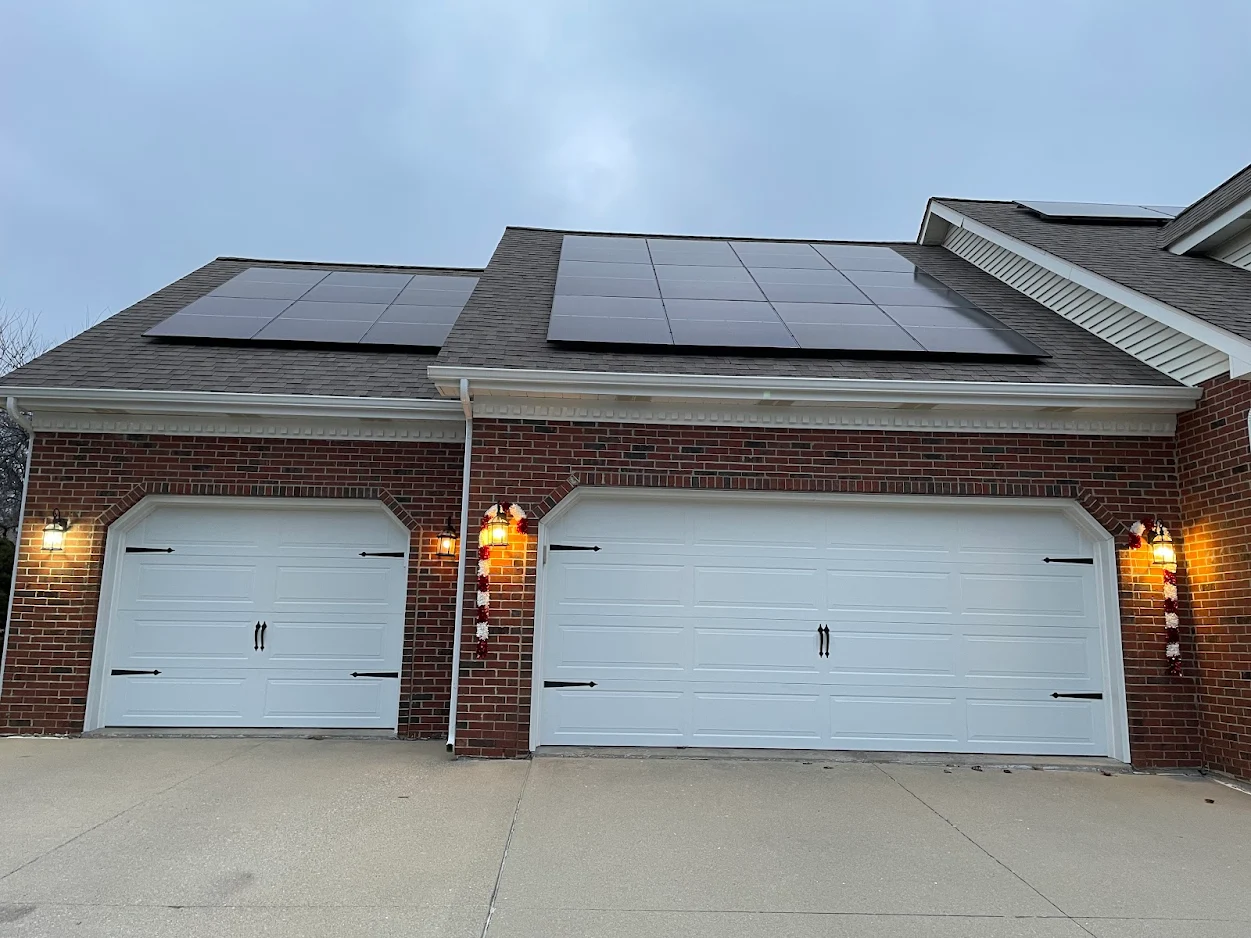
A land lease turns your acres over to someone else's power plant. The other path is panels that power your own house, shop and grain dryer. The AIMA rules don't cover that kind of setup. Projects on the customer's side of the meter, sized mainly to offset that customer's own use and at 2,000 kilowatts or less, are carved out.
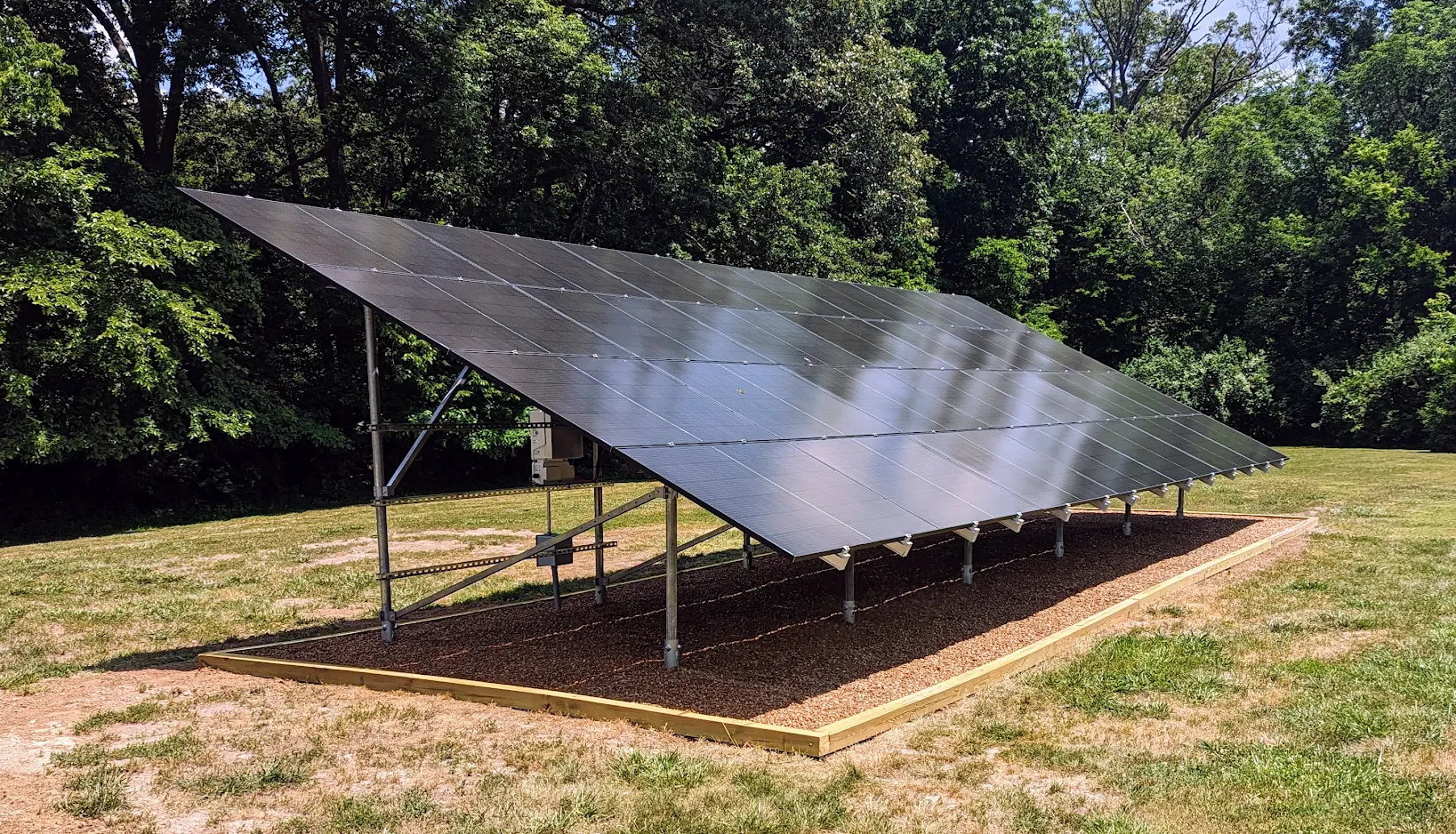
For a farm family, that usually means a ground-mounted array on a corner of ground that doesn't farm well, or panels on a machine shed. If you own the system, Illinois Shines pays you for the renewable energy credits it produces. You can estimate that payment with our REC calculator. If you'd rather own than lease, our lease vs. buy breakdown walks through both, and bigger farm operations can start on our commercial solar page.
The two paths can coexist. Some families lease the back 80 to a developer and still put their own array by the shop.
My take
If a developer is offering you $1,000 an acre or more, that's in line with what Illinois professionals reported this year. A number in the $400s isn't. The rate is the easy part to compare. The hard part is the long promise behind it, and the Illinois AIMA gives you a solid floor on drainage, topsoil and removal that you can build on in the lease.
Want to know what your own farmhouse, shop or bins could save with panels of your own? Run the numbers on our solar calculator, or call me at (618) 217-2001. You can also reach us through the contact page.
Sources
- Illinois Society of Professional Farm Managers and Rural Appraisers, "Farmland Values Flat to Modestly Lower in First Half of 2026" (Mid-Year Snapshot Survey, Aug 27, 2026; posted Aug 31, 2026): https://ispfmra.org/2026/08/31/farmland-values-flat-to-modestly-lower-in-first-half-of-2026/
- Illinois Department of Agriculture, Agricultural Impact Mitigation Agreements (accessed Oct 9, 2026): https://agr.illinois.gov/resources/aima.html
- Illinois Department of Agriculture, Standard Solar Agricultural Impact Mitigation Agreement, V.8.19.19: https://agr.illinois.gov/content/dam/soi/en/web/agr/resources/aima/documents/std-solar-aima.pdf
- Illinois Property Tax Code, 35 ILCS 200/10-745, real estate taxes on commercial solar energy systems (P.A. 100-781, 101-81): https://www.ilga.gov/legislation/ilcs/fulltext.asp?DocName=003502000K10-745
- Illinois Property Tax Code, 35 ILCS 200/10-740, survey and separate parcel number for ground-installed commercial solar (P.A. 100-781): https://www.ilga.gov/legislation/ilcs/fulltext.asp?DocName=003502000K10-740