Can Solar Panels Run a Heat Pump in Illinois? Only With Summer Credits, and Here's the Math
Solar panels can run a heat pump in Illinois over a full year, but not in January. A heat pump adds an estimated 5,600 to 6,700 kWh a year to a home that used to heat with gas, and about 81% of Chicago's normal heating demand falls between November and March, when panels make the least. What makes it work is the bill-credit bank: panels sized for the heat pump overproduce from spring through fall, and those credits pay for winter. Credits only cover part of the bill, though, so I'll show you the month-by-month math and the ComEd rate class that cuts the rest.
I get this question a lot from people pricing a heat pump with a utility rebate. A lot of the answers online are national averages or come from the UK. Illinois winters and Illinois billing rules change the answer.
The numbers this is built on
| Fact | Figure | Source and date |
|---|---|---|
| Heat pump electricity added to a gas-heat home | est. 5,600 to 6,700 kWh/yr (6,000 used below) | Our heat pump vs. gas furnace breakdown, Sept. 2026 |
| Chicago O'Hare heating degree days, Nov. to Mar. | 4,839 of 5,974 a year (81%) | NWS Chicago, 1991–2020 normals |
| Solar output, south-facing, 30° tilt | 1,342 kWh per kW a year (Chicago); 1,430 (Belleville) | PVWatts v8 |
| Solar output per kW, December | about 66 kWh (Chicago); about 85 kWh (Belleville) | PVWatts v8 |
| ComEd credits for systems connected Jan. 1, 2025 or later | Offset the Supply section; do not expire | ComEd Net Metering FAQ (2026 edition) |
| ComEd delivery, single-family | 6.333¢/kWh standard; 3.215¢/kWh electric space heat | ComEd delivery guide, bills from April 2026 |
| ComEd price to compare | 10.103¢/kWh | Oct. 1, 2026 – May 31, 2027 (Plug In Illinois) |
Why winter is the whole problem
Heat pump electricity follows the cold, and the cold in Illinois is lopsided. The National Weather Service's 1991–2020 normals give Chicago O'Hare 5,974 heating degree days a year. January alone has 1,234. July has 2. Rockford runs colder still, at 6,497.
Solar does the opposite. A south-facing kilowatt of panels in Chicago makes about 153 kWh in July and about 66 in December, according to PVWatts.
I spread a 6,000 kWh heat pump across the year in proportion to those degree days. January comes out around 1,240 kWh of heat pump use. Each kilowatt of panels makes about 75 kWh that month. Covering January's heating in January would take about 16.6 kW, roughly 41 panels. Almost nobody has the roof for that, and you'd be drowning in surplus by June.
And the real January is a little worse than my model. A heat pump gets less efficient as it gets colder. ENERGY STAR's cold-climate label only requires a coefficient of performance of 1.75 at 5°F, so the deep-cold days use more electricity per unit of heat than the season average.
How the summer bank carries the winter
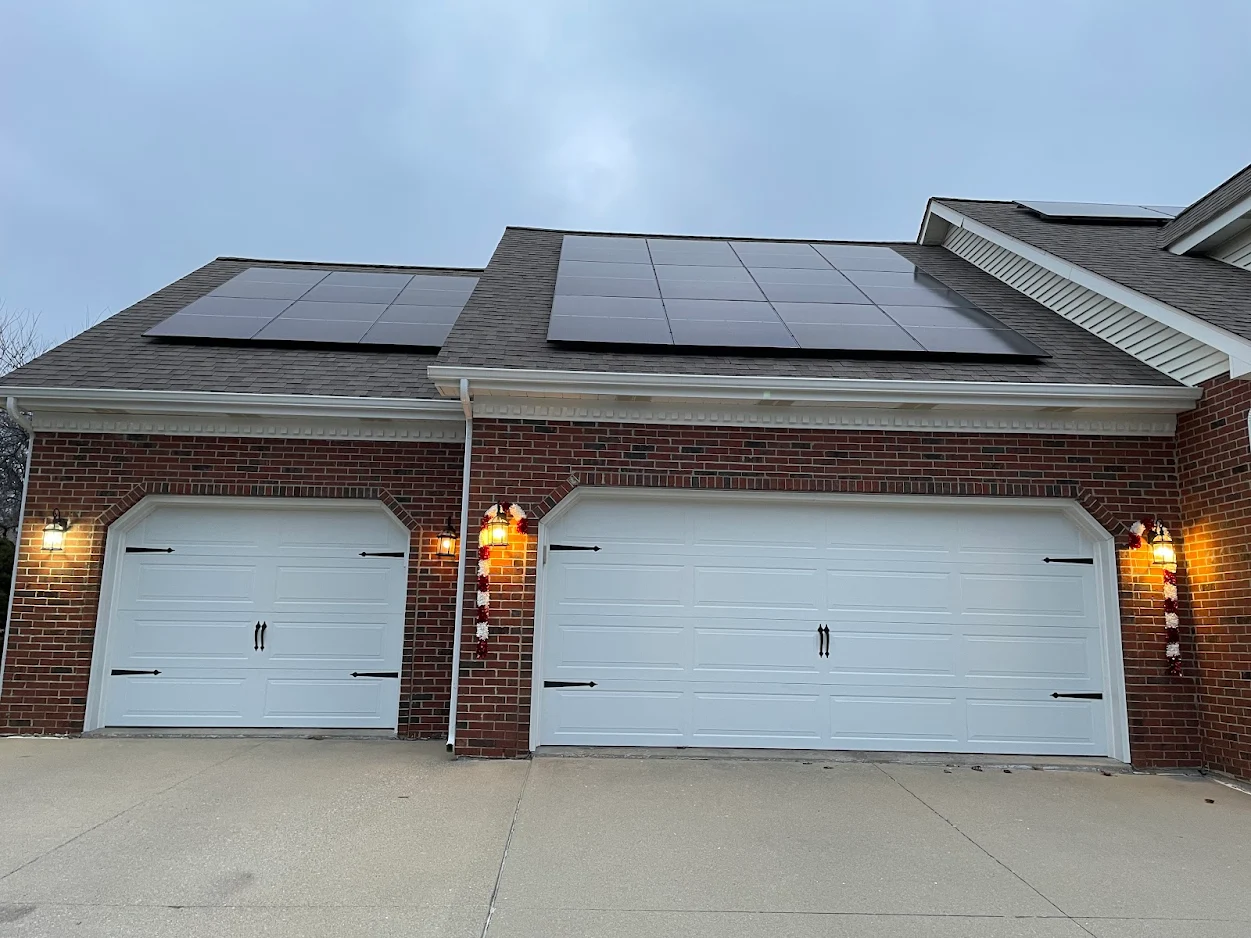
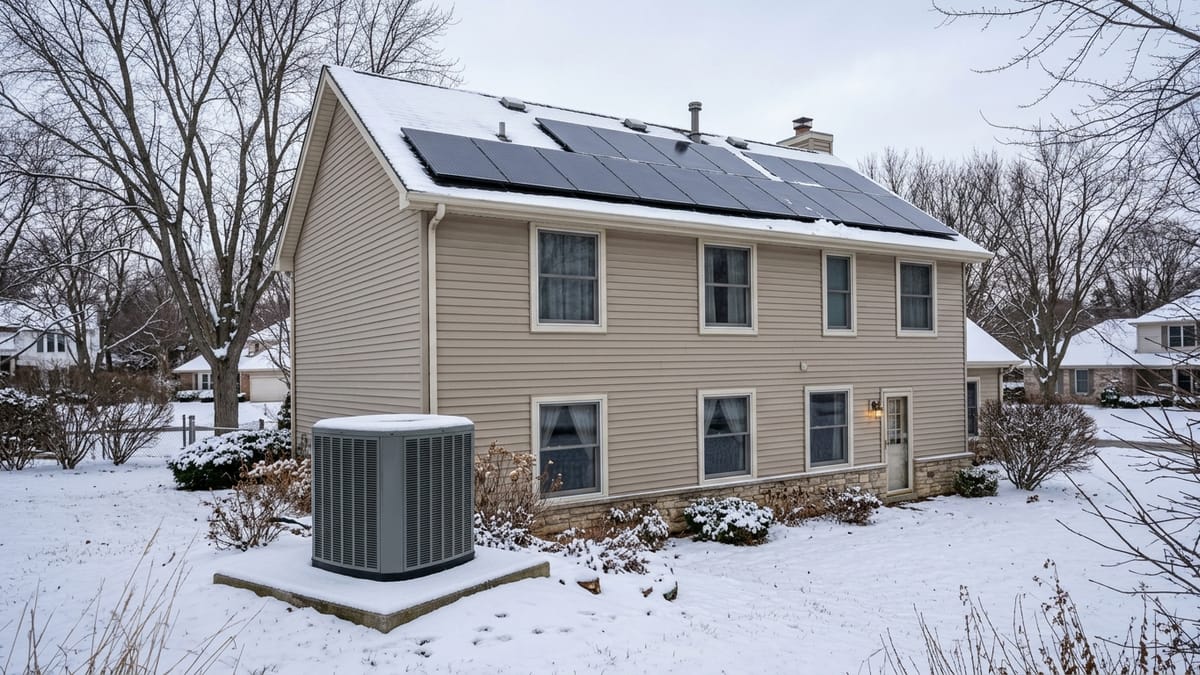
Here's the same Chicago-area house with a system sized for the heat pump: the average Illinois home's 693 kWh a month plus 6,000 kWh of heat pump, about 14,300 kWh a year. That's 27 panels of 400 watts (10.8 kW), facing south. I held the rest of the house flat at 693 kWh a month so the heat pump's effect stands out.
| Month | Panels make (est.) | House uses (est.) | Credit bank at month end (est.) |
|---|---|---|---|
| April | 1,378 kWh | 1,163 kWh | 215 kWh |
| June | 1,511 kWh | 724 kWh | 1,568 kWh |
| August | 1,488 kWh | 697 kWh | 3,316 kWh |
| October | 1,089 kWh | 1,050 kWh | 3,926 kWh |
| November | 844 kWh | 1,409 kWh | 3,361 kWh |
| December | 710 kWh | 1,767 kWh | 2,304 kWh |
| January | 806 kWh | 1,932 kWh | 1,178 kWh |
| February | 994 kWh | 1,712 kWh | 460 kWh |
| March | 1,218 kWh | 1,505 kWh | 173 kWh |
The bank peaks around 3,900 kWh at the end of October, then the heat pump spends it down to almost nothing by spring. Over the year the panels make an estimated 14,489 kWh against 14,316 used.
That only works because ComEd's credits stick around. Its net metering FAQ says credits "do not expire for customers who interconnected on January 1, 2025 or later." If you have an older system on fixed pricing, your kWh credits reset each April or October, and an October date would wipe the bank right before you need it. I wrote up how to check which date you have.
What the credits don't cover
This is the part the national guides skip. Since 2025, new ComEd solar customers get credits that "offset charges in the Supply section of the bill." Ameren says its new customers receive "only supply and transmission service credits." So your summer surplus can pay for winter supply. It doesn't pay delivery on the power the grid sends you in December. The 2025 net metering change explains why.
In the table above, the months where the house uses more than the panels make add up to about 3,750 kWh of grid power. That's a floor, by the way. A heat pump runs hard at night, when panels make nothing, so the grid delivers more than the monthly totals show.
Delivery on just that 3,750 kWh, before the fixed charges:
- ComEd standard single-family class (6.333¢ plus 0.128¢ tax): about $242 a winter
- ComEd electric space heat class (3.215¢ plus 0.136¢ tax): about $126 a winter
I think that second line is the most underused number in Illinois home electrification.
Ask ComEd for the space-heat rate
ComEd's wording: customers "who install an electric heat pump that converts their heating system, including any back-up and/or secondary heating, to all-electric qualify for the electric space heat rate." It costs about $3.17 a month more in fixed charges and cuts delivery roughly in half, and ComEd says it lowers the cost of "the entire electricity consumption, not just the heating and cooling."
Two warnings. A dual-fuel system that keeps a gas furnace as backup doesn't meet that "all-electric" test. And don't assume the change happens on its own. ComEd's advice is to call 1-800-EDISON1 to see if you qualify, so call after the install and check the rate description under Charge Details on your next bill. I walked through the full class comparison in ComEd's electric space heat rate explained.
The expensive mistake: sizing solar to last year's bill
Solar quotes are usually designed off your last 12 months of usage. If those months were gas-heated, the design won't include the heat pump.
Same house, but with the 15-panel system sized to its old 8,316 kWh a year, and the heat pump added afterward. My model leaves an estimated 6,270 kWh a year the panels never cover. At ComEd's 10.103¢ price to compare plus standard delivery, that's roughly $1,040 a year before taxes and riders, or about $840 on the space-heat class.
Adding panels later is possible, but it usually means another permit, another interconnection application and another truck roll. If a heat pump is coming in the next couple of years, tell your solar company now and design for it. The how many solar panels do I need table has an "average home plus a heat pump" row for this reason.
Downstate is a gentler version
Ameren Illinois homes have two things going for them. Panels make more in winter: about 85 kWh per kilowatt in December in Belleville against about 66 in Chicago. And Ameren's winter pricing rewards heavy use. From October through May, kWh above 800 a month cost 8.262¢ for supply plus 2.427¢ for delivery (2.488¢ on 2027 bills), about 10.7¢ before taxes and riders. Those are the kWh a heat pump adds.
In Ameren territory, then, the winter gap stings less, and solar earns its keep in summer, when delivery runs 7.811¢ (8.009¢ on 2027 bills). My heat pump rebates guide covers what Ameren and ComEd pay toward the unit itself.
Where a battery fits, and where it doesn't
A home battery moves power by hours, not by seasons. It can push afternoon solar into the evening when the heat pump kicks on, and it keeps the house running in an outage. It can't carry October's surplus into January. The winter gap in my example is hundreds of times what a home battery holds. The credit bank does the seasonal work. See how big a battery you actually need for the daily math.
My take
If you're going all-electric, solar and a heat pump belong in the same conversation. One adds winter load. The other banks summer credits to cover it. Price them separately and you'll probably get the sizing wrong.
For a lot of families I'd lead with a lease here. It's $0 down, a battery is included, and the 25-year term means your power is billed at a predictable rate, as low as $0.10 per kWh, with the full schedule set in your contract before you sign. The company that owns the panels takes on the equipment risk, and the design can be built around the heat pump from day one. If you'd rather own, the same sizing rule applies. Our lease vs. buy breakdown lays them side by side, and Illinois Solar for All is worth a look first if money's tight.
Send me a recent gas bill and a recent ComEd or Ameren bill. I'll estimate what a heat pump would add, how many panels it takes to cover it, and which rate class you should be in. Call (618) 217-2001, run your numbers through the savings calculator, or get in touch here.
All production, usage and dollar figures are estimates from public data and a simplified monthly model, not a quote. Your home's numbers will differ.
Sources
- National Weather Service Chicago, Monthly and Yearly Normals, O'Hare and Rockford, 1991–2020 (heating degree days: O'Hare 1,234 Jan., 1,015 Feb., 808 Mar., 713 Nov., 1,069 Dec., 5,974 annual; Rockford 6,497 annual): https://www.weather.gov/lot/ord_rfd_monthly_yearly_normals
- PVWatts v8 calculator, National Laboratory of the Rockies (U.S. DOE): Chicago (41.88, −87.63) and Belleville (38.52, −89.98), fixed roof mount, 30° tilt, south (180°), 14% losses, results scaled per kW: https://pvwatts.nlr.gov/
- ComEd, Net Metering Frequently Asked Questions (NMR1225, © 2026; credits for systems interconnected January 1, 2025 or later offset the Supply section and do not expire): https://www.comed.com/cdn/assets/v3/assets/blt3ebb3fed6084be2a/bltceb8d9495434223b/695be67c33699162b6ea350c/20065_Net_Metering_FAQ_2025_1223A.pdf
- Ameren Illinois, Changes to Illinois' Net Metering Program (new customers from January 1, 2025 receive supply and transmission service credits): https://www.ameren.com/-/media/illinois-site/files/electricchoice/changes-to-aic-net-metering.ashx
- ComEd, A Guide to the Retail Customer's Billed Delivery Service Charges, charges beginning with April 2026 bills (single-family 6.333¢ + 0.128¢; single-family electric space heat 3.215¢ + 0.136¢; fixed charges): https://www.comed.com/cdn/assets/v3/assets/blt3ebb3fed6084be2a/blt7904befea93c3525/6a74ab1af8608b565710881f/A_Guide_to_the_Retail_Customer_s_Billed_Delivery_Service_Charges.pdf
- ComEd Go Electric, Savings Calculator notes (electric space heat rate eligibility for heat pump conversions incl. backup heating; 1-800-EDISON1; applies to entire consumption), accessed Nov. 2, 2026: https://goelectric.comed.com/savings-calculator/
- Illinois Commerce Commission, Plug In Illinois, ComEd Price to Compare (10.103¢, Oct. 1, 2026 – May 31, 2027): https://plugin.illinois.gov/understanding-the-price-to-compare/price-to-compare-comed.html
- Illinois Commerce Commission, Plug In Illinois, Ameren Illinois Price to Compare (10.441¢ first 800 kWh / 8.262¢ above, Oct. 1, 2026 – May 31, 2027): https://plugin.illinois.gov/understanding-the-price-to-compare/price-to-compare-ameren-illinois.html
- Ameren Illinois, Rate PBR-R Appendix, effective Aug. 28, 2025 (DS-1 delivery 2026: 7.811¢ summer; 4.572¢ first 800 kWh and 2.427¢ above, non-summer; 2027: 8.009¢ summer, 2.488¢ above 800 kWh non-summer): https://www.ameren.com/-/media/rates/illinois/residential/electric-rates/distribution-delivery/aiel8rtpbrr08282025.ashx
- U.S. Energy Information Administration, Electric Power Monthly Table 5.A (Illinois residential average 693 kWh/month, 2024): https://www.eia.gov/electricity/sales_revenue_price/pdf/table_5a.pdf
- ENERGY STAR, Version 6.2 Heat Pump Specification, March 2025 (cold climate: COP ≥ 1.75 at 5°F): https://www.energystar.gov/sites/default/files/2025-04/ENERGY%20STAR%20Version%206.2%20Heat%20Pump%20Specification%20Rev.%20March%202025.pdf