Do Solar Panels Cause Roof Leaks? The Illinois Warranty Line to Check Before You Sign
No, solar panels don't cause roof leaks. The holes that hold them can. A roof-mounted system is bolted through your shingles into the rafters, and every attachment point has to be flashed and sealed. When one is done badly, water finds it. In Illinois, the protection is a single line on the Illinois Shines disclosure form you sign before the contract: "Warranty against roof leaks from installation," with who provides it and for how many years. On the program's June 2026 sample forms the example says 5 years, and the state sets no minimum.
That one line tells you more about an installer than the brochure does. Here's what to look for, why winter makes this worse, and what to do if a stain shows up on your ceiling.
Where the water actually gets in
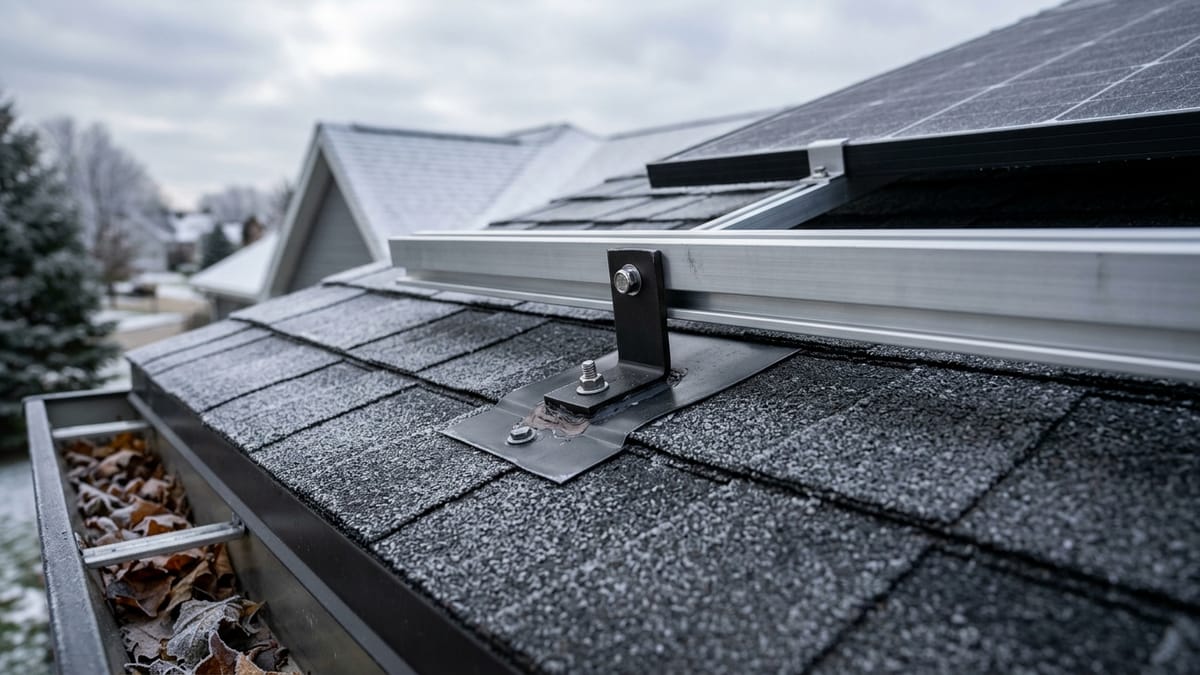
Every roof-mounted array sits on rails, and the rails sit on mounts screwed through the shingles into the rafters below. Each mount needs flashing, a metal or composite piece that slides under the shingle course above it so water runs over the hole instead of into it.
When a solar roof does leak, the usual culprits are workmanship mistakes like these:
- A mount that missed the rafter and got screwed into bare decking
- Sealant gobbed on where flashing should have been
- Cracked or scuffed shingles from a crew walking the roof in July heat
- Wiring run through the roof deck instead of along it, with a poor seal at the entry
None of those are the panel's fault. They're workmanship. That's not a knock on solar. It's a reason to care who's holding the drill.
What Illinois makes your installer put in writing
Illinois Shines puts a lot of consumer rules around solar, and several of them touch your roof directly.
| Rule | What it says | Where it comes from |
|---|---|---|
| Workmanship and roof condition | Approved Vendors must ensure their work "does not create safety hazards or property damage from poor workmanship," and that for any roof-mounted project "the roof condition is adequate" | IPA Consumer Protection Handbook, program year beginning June 2026 |
| Roof-leak warranty line | The disclosure form lists "Warranty against roof leaks from installation," who provides it, and for how many years | Illinois Shines Purchase and Lease Disclosure Forms (samples posted June 1, 2026) |
| Warranty terms in the contract | If a contract includes a warranty it must state the term, the provider, defects covered ("faulty installation … roof damage"), financial limits, and how to file a claim | Illinois Shines DG Contract Requirements, 2026-27 |
| Removal on early termination | If a lease or PPA is terminated and the system is removed, the contract "must explain who has responsibility for any necessary roof repairs" | Illinois Shines DG Contract Requirements, 2026-27 |
| Complaint line | Illinois Shines Program Administrator: (877) 708-3456 or complaints@illinoisshines.com | Illinois Shines Disclosure Forms, June 1, 2026 |
Read the warranty-terms row twice. The rule says if the contract includes a warranty. Illinois requires the installer to disclose a roof warranty. It doesn't require them to offer one, and it doesn't set a length.
On the state's June 2026 sample forms, the made-up installer offers 5 years on roof leaks for both the purchase and the lease example. An older 2023-24 purchase sample showed 10. Those are examples, not standards, but they show the range you'll see in real quotes. My take: 5 years is thin for a hole in your roof that has to last 25. Ask for more, and if a company won't put a number on that line, that's your answer.
Lease or buy changes who you call
This is the part most national "do solar panels damage your roof" articles skip, because it depends on Illinois paperwork.
If you buy, you own the system, and repairs to it are generally yours unless the contract says otherwise. On the 2026 purchase sample, "Project repairs" reads "Not Included." Your roof coverage is whatever the leak-warranty line says, and when it runs out, so does the installer's obligation.
If you lease, someone else owns the hardware. On the 2026 lease sample, project repairs are covered by the lessor for 20 years. That's one reason I lead with leases for most homeowners: equipment problems land on the owner, not you, and maintenance is covered. But the roof is still your roof. The leak-warranty line on a lease form is its own line with its own number of years, and on the sample it's still 5. Ask about it separately, and read the removal clause too. Our lease vs. buy breakdown covers the rest of that paperwork.
Either way, your homeowners policy may or may not step in. I covered the gaps in whether homeowners insurance covers solar panels in Illinois.
Winter is when the blame shows up
In an Illinois winter, a lot of what gets called a "solar leak" isn't a solar leak at all. It's an ice dam.
North Dakota State University Extension explains it simply: heat from the house warms the roof, the snow melts, and the water refreezes when it hits the colder eaves. That ridge of ice backs the meltwater up, "allowing it to leak under the shingles into the attic or eaves." If that water happens to show up near a row of mounts, the panels take the blame.
The fix is a cold roof, not a different solar company. NDSU's advice is enough attic insulation and ventilation "to keep the roof near outdoor temperatures." If your house grows a curtain of icicles every winter, deal with the attic before panels go on. It's cheaper to fix with nothing on the roof.
One more winter note: you don't need to climb up and scrape snow off panels, and you shouldn't. Our post on snow and solar panels in Illinois explains why leaving it is usually the right call.
Start with a roof that deserves the panels
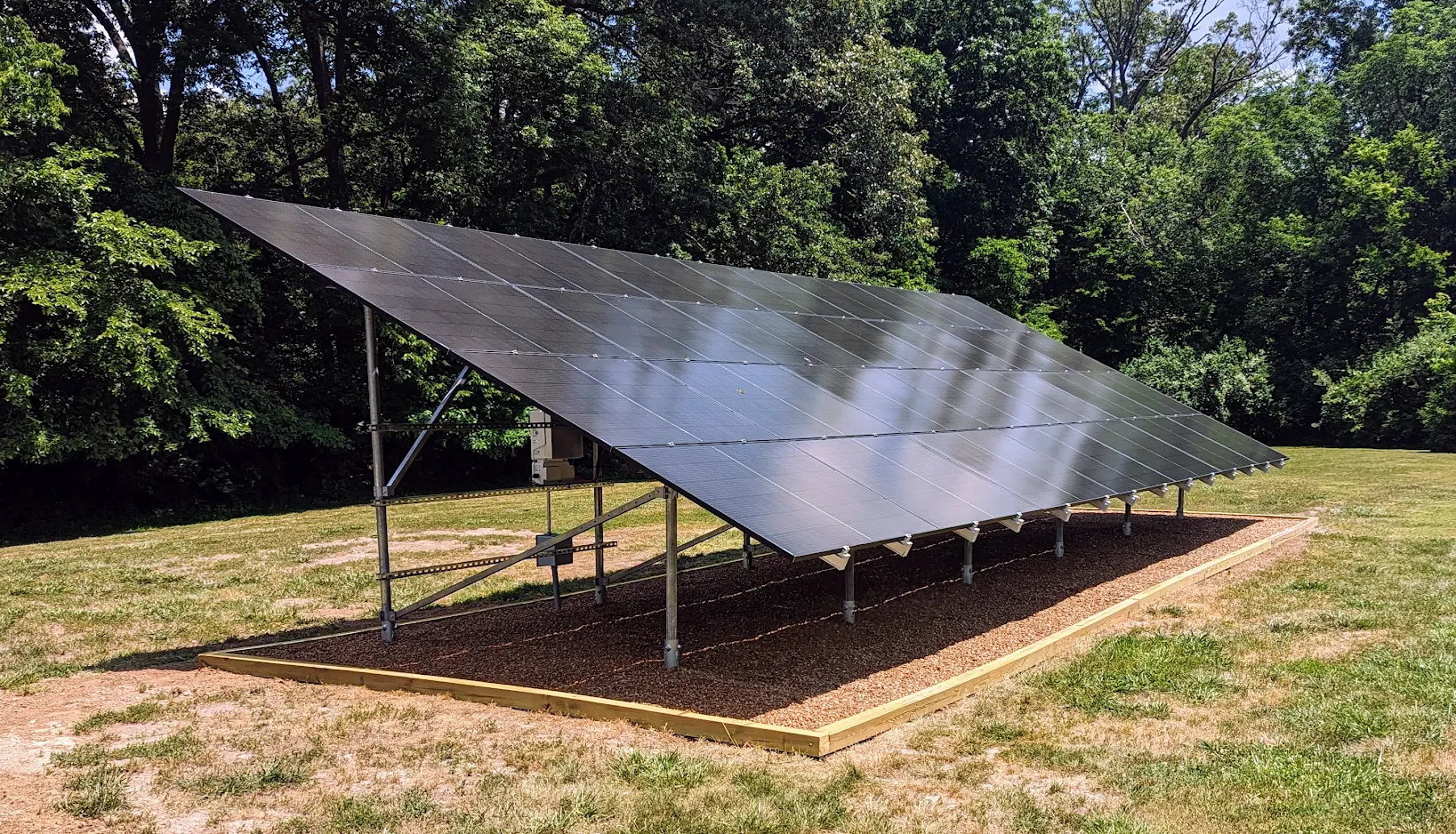
The best leak prevention happens before anyone signs. If your shingles have less than about 10 years left, replace them first. Pulling a system off later for a re-roof runs an estimated $2,800 to $6,000, which I broke down in do you need a new roof before solar. If the roof can't take panels at all, ground-mount solar puts zero holes in it.
Ask one more question: who does the flashing? Illinois licenses roofers under the Roofing Industry Licensing Act (225 ILCS 335), which covers work on "all kinds of roofing and waterproofing as related to roofing over an occupiable space." The Act doesn't mention solar, so I won't tell you it requires a roofing license for mounts. But it costs nothing to ask whether the crew sealing your roof holds one or works with someone who does. That's why we handle roofing and solar together when the roof needs work.
If you see a stain, the first 48 hours matter
- Document it. Photos of the ceiling stain, any drip, and the roof under the array taken from the ground. Date everything.
- Limit the damage. Bucket, towels, move what can be ruined. Don't wait for the installer to tell you to.
- Notify in writing. Email or text the installer (or the leasing company) with the photos and ask for a repair date. A written record beats a phone call.
- Don't pull mounts yourself or send your own roofer up without the system owner's sign-off, especially on a lease.
- Escalate if they go quiet. Illinois Shines takes complaints at (877) 708-3456 or complaints@illinoisshines.com.
Speed matters for a reason beyond drywall. The state's Consumer Protection Handbook uses a roof leak as its example of why customers must act fast: if an installer damages a roof and the customer "waits a week or two before notifying the installer," compensation may not cover harm that prompt action would have avoided. (The Solar Restitution Program is limited in its first phase to unpaid REC pass-through payments, so treat that line as guidance on how the state thinks, not a payout you can claim today.)
And go in knowing the odds. The IPA's annual complaint report counted 832 Illinois Shines complaints in 2025. Mechanical or installation issues topped the list at 228, and more than half of those also cited a company that didn't respond. A leak is fixable. A company that won't answer is the real risk, which is why who fixes your solar panels matters as much as who installs them.
My bottom line
Solar doesn't ruin roofs. Rushed installs on tired roofs do. Before you sign, find the roof-leak warranty line on your disclosure form, get the number of years, and make sure the roof under it has the life to match.
If you want a first look at whether your roof is a good candidate, check my roof uses satellite data, and our savings calculator shows what a system could do against your Ameren or ComEd bill.
Sources
- Consumer Protection Handbook and Illinois Shines DG Contract Requirements, 2026-27 program year (IPA Appendix H-1; Contract Requirements published April 17, 2026)
- Illinois Shines Solar Project Lease Disclosure Form, sample (June 1, 2026)
- Illinois Shines Solar Project Purchase Disclosure Form, sample (June 1, 2026)
- Illinois Shines Sample DG Purchase Disclosure Form, PY 2023-2024
- IPA 2025 Consumer Complaints & Disciplinary Actions Annual Report, errata (Feb. 27, 2026; corrected Apr. 22, 2026)
- Illinois Roofing Industry Licensing Act, 225 ILCS 335 (Illinois General Assembly)
- Reduce ice dam and icicle damage (NDSU Extension, Jan. 4, 2023)
Questions about a quote in front of you, or a roof you're not sure about? Call me at (618) 217-2001 or reach out here and I'll walk through the warranty lines with you.